
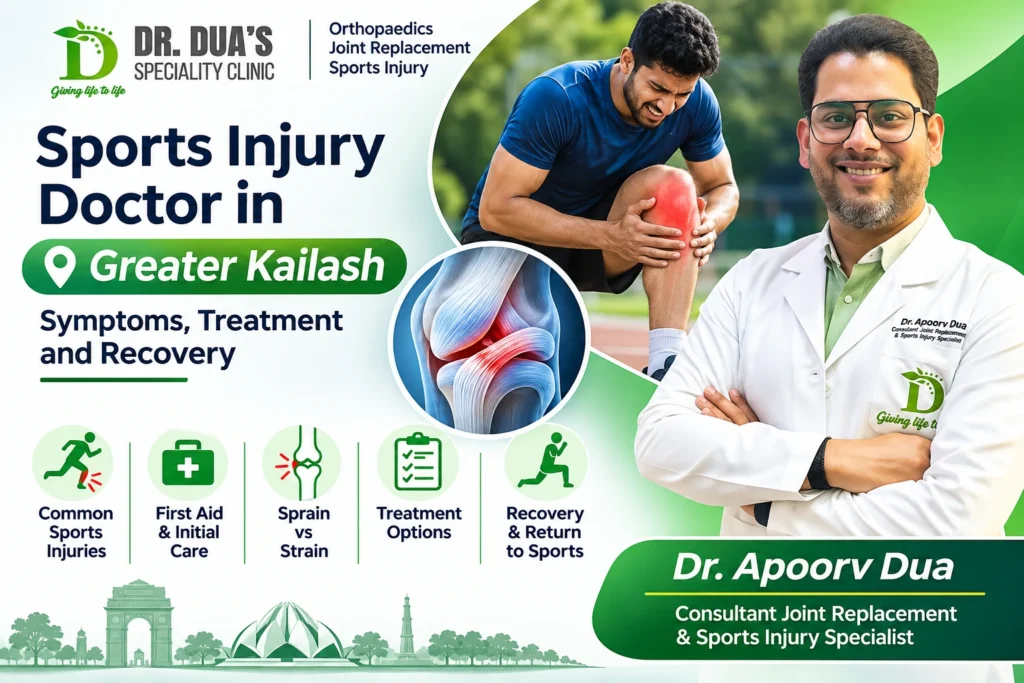
Sports Injury Doctor in Greater Kailash: Symptoms, Treatment and Recovery
By Dr. Apoorv Dua, Orthopedic Surgeon (MBBS, M.S. Orthopaedics; fellowships in joint replacement, ligament reconstruction, and shoulder arthroscopy and sports medicine; FIFA Diploma), Dr. Dua’s Speciality Clinic, Greater Kailash II. Last updated: 11 November 2026.
It happens in a second. You land awkwardly after a jump. A shoulder gives way during a tackle. A hamstring tightens in the middle of a sprint. You hope it will settle by morning. Sometimes it does. Often, it does not. If you are looking for a sports injury doctor in Greater Kailash, this guide is for you. It explains common sports injuries, what you can do at home, when to see a doctor, and how recovery should work.
Quick answer: A sports injury doctor is an orthopedic surgeon trained to diagnose and treat injuries to muscles, ligaments, tendons and joints, and to guide you back to activity safely. See one if pain, swelling or instability lasts beyond a few days, or at once after a hard fall or a joint that gives way. Dr. Apoorv Dua at Dr. Dua’s Speciality Clinic, Greater Kailash II, holds an IOA fellowship in shoulder arthroscopy and sports medicine and a FIFA Diploma.
What counts as a sports injury?
A sports injury is any injury that happens during exercise or sport. It is not only for athletes. Weekend cricketers, gym-goers, runners, dancers and even morning walkers get hurt. In fact, most of the patients we see are everyday people, not professionals.
Common sports injuries
- Sprains: a stretched or torn ligament, such as in the ankle or knee
- Strains: a pulled or torn muscle or tendon, such as the hamstring
- ACL and other ligament tears: often from a sudden twist or stop
- Meniscus tears: damage to the cartilage pad in the knee
- Shoulder injuries: rotator cuff tears, dislocations and instability
- Tendon problems: tennis elbow, Achilles tendon pain and patellar tendon pain
- Fractures: stress fractures and breaks from falls or collisions
Our page on the sports injury centre lists the conditions we treat.
First aid: what to do in the first days
For many mild injuries, early care helps. The usual approach is RICE:
- Rest: stop the activity, and avoid pain-causing movement
- Ice: apply a wrapped ice pack for short periods
- Compression: use a bandage to limit swelling
- Elevation: raise the limb above heart level when you can
RICE can ease swelling and pain. However, it does not tell you what is torn. So, if the pain is strong, or the joint feels loose, get it checked.
When should you see a sports injury doctor in Greater Kailash?
See a doctor soon if you notice:
- Pain or swelling that does not improve in a few days
- A joint that feels loose, gives way or locks
- A pop at the time of injury, followed by swelling
- Trouble putting weight on the limb
- Numbness, tingling or weakness
- Visible deformity, which may mean a fracture or dislocation
Visible deformity or severe pain after a fall needs urgent care. Do not wait for it to settle.
How a sports injury is diagnosed
- Your story. How you got hurt gives strong clues.
- Examination. The doctor checks swelling, movement, stability and strength, and uses specific tests for each joint.
- X-ray. It shows bones, and it rules out a fracture.
- MRI or ultrasound. These show ligaments, tendons, muscles and cartilage when needed.
A careful examination matters as much as a scan. For example, OrthoInfo notes that X-rays do not show a meniscus tear, while an MRI is the most accurate imaging option. The right test depends on the injury.
Do all sports injuries need surgery?
No. Most do not. In fact, many injuries recover well with rest, guided exercise and gradual return to activity. A trustworthy sports doctor explains this clearly. Surgery becomes the answer when:
- Ligament tears leave the joint unstable, as with some ACL tears
- Meniscus or rotator cuff tears cause persistent pain or weakness
- A fracture or dislocation needs fixing
- Rehabilitation has not worked, and daily life or sport still suffers
When surgery is needed, many procedures use arthroscopy, which means small cuts and a camera. Read about ACL and PCL surgery, rotator cuff repair and frozen shoulder treatment.
Knee, shoulder or ankle: injuries by joint
Knee: twisting injuries can tear the ACL or meniscus. Our guide on an orthopedic specialist for knee in Greater Kailash explains the options.
Shoulder: overhead sports, falls and sudden jerks can strain the rotator cuff or loosen the joint. Dr. Dua holds an IOA fellowship in shoulder arthroscopy and sports medicine.
Ankle: sprains are the most common sports injury. Even so, repeated sprains can mean unstable ligaments. See our guide to ankle sprain treatment.
Non-surgical help
Many patients recover without an operation. Options include rest from the aggravating activity, bracing, physiotherapy and strengthening. Some also ask about injections made from the patient’s own blood. The evidence for these is mixed, so read our guide on PRP therapy for knee in Greater Kailash before you decide. The clinic also lists GFC therapy. Ask Dr. Dua whether either option suits your injury.
Rehabilitation: the part that decides the result
Treatment does not end with the scan, the brace or the operation. Rehabilitation decides how well you return. A good plan usually moves through stages:
- Calm the injury. Reduce pain and swelling.
- Restore movement. Regain full, comfortable range.
- Rebuild strength. Train the muscles that protect the joint.
- Train for your sport. Practice the movements you need.
- Return gradually. Go back only when the doctor clears you.
Rushing is the most common cause of re-injury. See our rehabilitation page for how recovery is supported.
Preventing sports injuries
- Warm up before you play, and cool down after
- Build strength and balance, not just stamina
- Increase training gradually
- Wear shoes and gear that fit your sport
- Rest when you feel pain, and do not play through it
- Sleep well, and eat and drink enough
How to choose a sports injury doctor in Greater Kailash
- Training in sports medicine. Look for fellowships in sports medicine and arthroscopy.
- A thorough examination. You should not leave with only a prescription.
- Honest advice. A good doctor tells you when surgery is not needed.
- A rehab plan. Ask who will guide your recovery.
- Return-to-sport guidance. You should know when it is safe to play.
About Dr. Apoorv Dua
Dr. Apoorv Dua is an orthopedic surgeon with an MBBS and M.S. in Orthopaedics. His training includes a fellowship in joint replacement and ligament reconstruction in Germany, and an IOA fellowship in shoulder arthroscopy and sports medicine. He also holds a FIFA Diploma. Read his full profile or see patient testimonials.
Clinic address: Dr. Dua’s Speciality Clinic, M-85, M Block, 80 Feet Road, Greater Kailash II, New Delhi 110048. OPD runs Monday to Saturday, 9 AM to 7 PM. Patients also visit from Chittaranjan Park, Lajpat Nagar, Defence Colony and Nehru Place.
Frequently asked questions
Who is a good sports injury doctor in Greater Kailash?
Look for sports medicine and arthroscopy training, a careful examination and honest advice. Dr. Apoorv Dua holds an IOA fellowship in shoulder arthroscopy and sports medicine.
When should I see a doctor for a sports injury?
See a doctor if pain or swelling lasts more than a few days, the joint feels loose or locks, or you cannot put weight on the limb.
Is RICE enough for a sports injury?
It helps for mild injuries in the first days. However, it does not show what is torn, so get strong pain or instability checked.
Do I need surgery for a ligament tear?
Not always. Some tears heal with rehabilitation, while others, such as many ACL tears in active people, may need surgery. Your doctor will advise after examination and imaging.
How long does recovery take?
It depends on the injury. A mild sprain may take weeks, while a repaired ligament or tendon takes months.
When can I return to sport?
Only when your doctor clears you, after strength, movement and stability return.
How do I book a consultation?
Use the appointment page or call +91-9034333133.
Hurt while playing? Book a consultation with Dr. Apoorv Dua in Greater Kailash II.
