

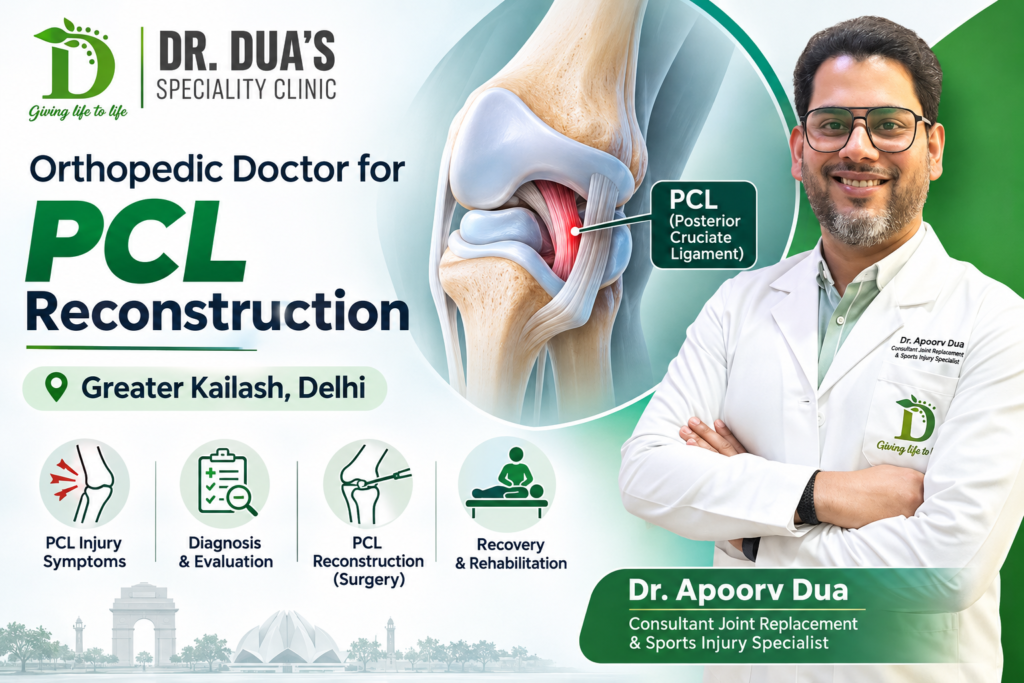
Orthopedic Doctor for PCL Reconstruction in Greater Kailash: Symptoms, Surgery and Recovery
By Dr. Apoorv Dua, Orthopedic Surgeon (MBBS, M.S. Orthopaedics; fellowships in joint replacement and ligament reconstruction, arthroplasty, and shoulder arthroscopy with sports medicine), Dr. Dua’s Speciality Clinic, Greater Kailash II. Last updated: 4 November 2026.
A knee that sags backwards, a car crash, or a hard fall on a bent knee. These are the usual stories behind a torn PCL. Many patients know about the ACL, but few have heard of the PCL until it fails. If you search for an orthopedic doctor for PCL reconstruction in Greater Kailash, this guide is for you. It explains what the PCL does, when it needs surgery, and how recovery works.
Quick answer: The PCL (posterior cruciate ligament) stops the shin bone from sliding backwards. Many isolated PCL tears heal with a brace and physiotherapy. Surgery, called PCL reconstruction, is advised for combined ligament injuries or for a knee that stays unstable. Dr. Apoorv Dua holds a fellowship in joint replacement and ligament reconstruction, and consults at Dr. Dua’s Speciality Clinic in Greater Kailash II.
What is the PCL?
The knee has four main ligaments. Two of them cross inside the joint, and they are called the cruciate ligaments. The ACL sits at the front. The PCL sits at the back, and it is thicker and stronger. Its job is simple. It keeps the shin bone from sliding backwards under the thigh bone.
According to OrthoInfo, the patient site of the American Academy of Orthopaedic Surgeons, the PCL is injured far less often than the ACL. For that reason, many people and even some clinics see few PCL cases. Experience therefore matters.
How do PCL injuries happen?
- Dashboard injury: the front of a bent knee hits the dashboard in a road accident
- Fall on a bent knee: common in football, kabaddi, cricket and cycling
- Hyperextension or twisting: the knee bends the wrong way during sport
- Multi-ligament injury: a severe knee dislocation can tear the PCL along with other ligaments
Because road accidents are a leading cause in Delhi, PCL injuries often come with other damage.
Symptoms of a PCL tear
- Pain and swelling that build quickly after the injury
- A stiff knee, and sometimes a limp
- Difficulty walking, especially downhill or downstairs
- A feeling that the knee may give way
- Pain at the back of the knee or behind the kneecap
Mild PCL tears can feel like a simple sprain. So, many people ignore them. However, an untreated unstable knee can wear out over time. Therefore, see a doctor if the pain or looseness lasts more than a week or two.
How is a PCL injury diagnosed?
- History. The doctor asks how the injury happened.
- Examination. Tests such as the posterior drawer test check how far the shin slides back.
- X-ray. It rules out fractures and shows bone alignment.
- MRI. It shows the PCL, other ligaments, the meniscus and cartilage.
Doctors often describe tears by grade, from a mild partial tear to a complete tear. The grade helps decide the treatment.
Treatment without surgery
Many isolated PCL tears are partial, and they often heal well. Treatment usually includes:
- Early rest, ice and elevation to calm swelling
- A brace that stops the shin from sagging backwards
- Physiotherapy to restore movement and strengthen the thigh muscles, especially the quadriceps
- A gradual return to walking and sport
Our rehabilitation programme guides each step. Sports players can also read our guide to sports injury treatment.
Orthopedic doctor for PCL reconstruction in Greater Kailash: when surgery is needed
Surgeons recommend PCL reconstruction in these situations:
- The PCL tears along with other ligaments, as in a knee dislocation
- An isolated tear leaves the knee unstable or painful despite proper physiotherapy
- A complete tear affects an active person who needs a stable knee
- Chronic looseness leads to pain or early wear
The torn ends of a PCL do not usually heal by stitching. So, the surgeon rebuilds the ligament with a graft. Our service page on ACL and ligament surgery in Delhi explains how the clinic approaches knee ligament care.
What happens in PCL reconstruction?
- Graft choice. The surgeon uses tissue from your own body, such as a hamstring or quadriceps tendon. Sometimes the surgeon uses donor tissue.
- Keyhole surgery. The surgeon works through small cuts with a camera, which is called arthroscopy.
- Tunnels and fixation. Small tunnels in the bone allow the graft to sit in the natural position of the PCL. Then the surgeon fixes it firmly.
- Other repairs. If the meniscus or other ligaments are torn, the surgeon treats them in the same session when needed.
The surgeon chooses the technique for your knee. So, ask why a particular graft and method suit you.
Recovery after PCL reconstruction
- First weeks: a brace protects the graft, and you start gentle movement under a physiotherapist
- 1 to 4 weeks: physiotherapy begins
- Several months: the graft heals into the bone, so you must avoid risky activity
- 6 to 12 months: full recovery for most patients, and return to sport depends on your progress
Rehab for the PCL is slow and careful, because the graft needs time. As a result, patience protects your knee. Do not rush back to football or cricket until your surgeon clears you.
Risks you should know
As with any operation, risks exist. They include stiffness, infection, blood clots, graft stretching and persistent looseness. Your surgeon should explain these before surgery. Good planning and strict rehab lower the chance of problems.
How to choose an orthopedic doctor for PCL reconstruction in Greater Kailash
- Look for ligament and arthroscopy training, not only general orthopedic training
- Ask how often the surgeon treats PCL and multi-ligament injuries
- Check that the doctor examines your knee carefully and explains the grade of your tear
- Ask about graft choice, rehab and the expected timeline
- Take a second opinion for major surgery
Dr. Apoorv Dua trained in joint replacement and ligament reconstruction in Germany. He also holds an IOA Inland Fellowship in Shoulder Arthroscopy and Sports Medicine and a FIFA Diploma. Read his profile and what patients say.
Related reading
Torn ACL? Read about ACL injury symptoms and recovery. Other knee problems? See our guide to the orthopedic specialist for knee in Greater Kailash and the sports injury centre.
Clinic location and timings
Dr. Dua’s Speciality Clinic is at M-85, M Block, 80 Feet Road, Greater Kailash II, New Delhi 110048. OPD runs Monday to Saturday, 9 AM to 7 PM, and the clinic is closed on Sunday. Patients also come from Chittaranjan Park, Nehru Place, Kailash Colony and Lajpat Nagar.
Frequently asked questions
What is PCL reconstruction?
It is surgery that rebuilds a torn posterior cruciate ligament with a graft, to restore stability to the knee.
Does every PCL tear need surgery?
No. Many isolated and partial tears heal with a brace and physiotherapy. Surgery is for combined injuries or a knee that stays unstable or painful.
How common is a PCL injury compared with an ACL injury?
PCL injuries are less common than ACL injuries. They often happen after road accidents or hard falls on a bent knee.
How long is recovery after PCL reconstruction?
Full recovery usually takes six to twelve months. Physiotherapy starts in the first weeks, and the graft takes months to heal.
Can I play sport after PCL surgery?
Most people return to sport once strength and stability return, which usually takes many months. Your surgeon will clear you.
How do I find an orthopedic doctor for PCL reconstruction in Greater Kailash?
Choose a surgeon with ligament reconstruction and arthroscopy training, regular experience, and a clear rehab plan. Dr. Apoorv Dua consults at Greater Kailash II.
How do I book an appointment?
Use the appointment page or call +91-9034333133.
Knee feels loose after an injury? Book a consultation with Dr. Apoorv Dua in Greater Kailash II.
