

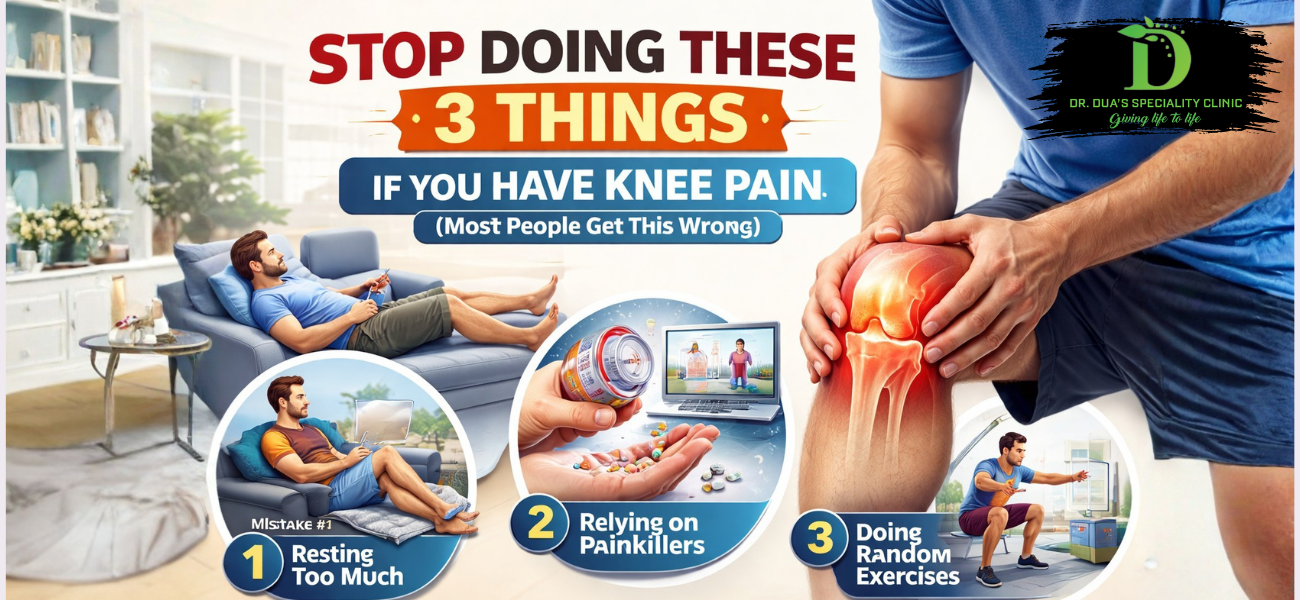
Knee pain does not start with a big injury for most people. It usually begins quietly. One day you feel discomfort while climbing stairs. Another day your knee feels stiff after sitting for a long time. Then, without warning, the pain becomes a daily problem.
At this stage, many people search online for quick fixes. They try painkillers, knee caps, hot packs, or random exercises. Some even stop walking completely. The result often stays the same: the knee pain keeps coming back, and the joint feels weaker month after month.
The real problem is not only the knee. The real problem is the way people react to knee pain. Most people make the same three mistakes, and these mistakes make the condition worse.
This blog explains those mistakes in a simple way. You will also learn what to do instead, how to reduce knee pain naturally, and when you should consult an orthopedic doctor for proper knee pain treatment.
Why Knee Pain Becomes a Long-Term Problem
Before we talk about the mistakes, you need to understand one thing clearly.
Knee pain is not a single disease. It is a symptom.
It can happen because of:
- early knee arthritis (osteoarthritis)
- cartilage wear and tear
- meniscus injury
- ligament strain
- patellofemoral pain (kneecap tracking issue)
- weak quadriceps muscles
- tight hamstrings or calves
- overweight pressure on the knee joint
- poor walking pattern
- vitamin D deficiency (in some cases)
That is why one person gets knee pain while walking and another person gets knee pain while sitting. That is also why some people feel pain in the front of the knee and others feel it inside or behind the knee.
If you treat knee pain without understanding the cause, the pain returns.
Now let’s talk about the biggest mistakes.
Mistake #1: Resting Too Much and Stopping Movement Completely
When knee pain starts, many people stop walking, stop using stairs, and stop exercising. They believe rest will heal the knee.
Rest helps in the first 1–2 days if you have sudden swelling or an acute injury. But long rest becomes the worst thing for knee pain.
Your knee joint needs movement to stay healthy. Your cartilage does not have its own blood supply like muscles. It gets nutrition from joint fluid. Movement helps that fluid circulate. Movement also keeps the muscles active.
When you stop moving:
- your quadriceps muscles weaken fast
- your knee becomes stiff
- your joint loses stability
- your walking pattern becomes worse
- your pain increases during daily activities
Many patients feel better for a few days because they avoid stress. But when they return to normal walking, the pain comes back even stronger.
What to do instead (the correct approach)
You need smart movement, not complete rest.
Start with low-impact activities that do not overload the knee:
- short walks on flat ground
- gentle stretching
- basic strengthening exercises
- cycling with low resistance (if comfortable)
- physiotherapy-guided rehab
If you feel pain while walking, reduce the distance. Do not stop completely.
If your knee has swelling, use ice for 10–15 minutes and then do gentle range-of-motion movements.
When rest is necessary
You should rest more if you have:
- sudden swelling after twisting the knee
- knee locking
- severe instability
- fever with knee pain
- sharp pain after a fall
In such cases, consult an orthopedic specialist early.
Mistake #2: Taking Painkillers Again and Again (Instead of Fixing the Cause)
Painkillers feel like the easiest solution. Many people with knee pain take tablets for weeks or months. Some people even take them daily.
Painkillers reduce inflammation and give short-term relief. But they do not rebuild cartilage. They do not correct muscle imbalance. They do not fix knee mechanics.
Painkillers also hide the warning signal. You feel better and continue doing the same activities that worsen your knee.
Long-term painkiller use can also cause:
- acidity and stomach issues
- kidney stress
- high blood pressure risk (in some cases)
- reduced natural healing response
That is why orthopedic doctors never want patients to depend only on painkillers.
What to do instead (the correct approach)
Use painkillers only as a short-term support.
Focus on long-term knee pain treatment:
- correct diagnosis (X-ray or MRI if needed)
- physiotherapy and strengthening
- weight management
- posture correction
- supportive footwear
- regenerative treatments like PRP injection for knee pain or GFC therapy in selected cases
If your knee pain lasts more than 10–14 days, you need a plan. You do not need stronger tablets.
Mistake #3: Doing Random Exercises From YouTube (And Making the Knee Worse)
This is the most common mistake in 2026.
People search “best exercise for knee pain” and start doing:
- deep squats
- lunges
- jump workouts
- aggressive stretching
- knee bends with weights
Some people do it daily because the video says it will “cure knee pain.”
The problem is simple: not every knee pain has the same cause.
If you have patellofemoral pain, deep squats may worsen pain.
If you have meniscus injury, twisting movements may worsen pain.
If you have arthritis, high-impact workouts can worsen swelling.
If you have weak glutes, your knee collapses inward during exercises and increases stress.
Random exercises can turn mild knee pain into a serious issue.
What to do instead (the correct approach)
Start with safe, knee-friendly movements.
A physiotherapist or orthopedic doctor can guide you based on your pain pattern. But in general, most people benefit from:
- gentle quadriceps strengthening
- straight leg raises
- hamstring stretching
- calf stretching
- hip strengthening
- balance training
The goal is not to force the knee. The goal is to support it.
Also, avoid pain-based training. If an exercise increases pain, stop it. Do not push through.
The Best Knee Pain Treatment Without Surgery (What Actually Works)
Now that you know the mistakes, let’s talk about solutions that work in real life.
Many people search for knee pain treatment without surgery. They want relief without a knee replacement. In many cases, this is possible, especially in early to moderate knee arthritis and non-severe injuries.
Step 1: Get the Right Diagnosis
You cannot treat what you do not understand.
A doctor checks:
- swelling
- tenderness location
- range of motion
- ligament stability
- meniscus signs
- walking pattern
An X-ray helps detect arthritis and joint space narrowing.
An MRI helps detect meniscus tears, ligament injuries, and cartilage damage.
A proper diagnosis saves months of trial-and-error.
Step 2: Fix the Root Cause (Not Just Pain)
Most knee pain improves when you fix:
- muscle weakness
- tight muscles
- excess weight pressure
- poor posture
- incorrect walking pattern
- overuse activities
This is why physiotherapy remains the foundation of knee pain relief.
Step 3: Physiotherapy (The Strongest Non-Surgical Treatment)
Physiotherapy improves:
- knee stability
- muscle strength
- joint mobility
- balance and coordination
- pain control
A good physiotherapy plan focuses on:
- quadriceps strengthening
- glute activation
- hamstring flexibility
- ankle mobility
- core stability
It also includes lifestyle advice like sitting posture and stair climbing technique.
Physiotherapy gives long-term improvement. It also reduces the risk of future knee damage.
Step 4: Weight Management (The Fastest Natural Relief)
If your weight is high, your knee carries much more load than you think.
Even a small weight reduction can reduce knee pain significantly.
Many patients feel noticeable improvement after losing 4–6 kg because knee joint stress drops.
Weight loss also improves PRP and GFC outcomes if you choose regenerative treatments.
Step 5: Footwear and Walking Correction
Most people ignore this completely.
Bad footwear increases knee stress:
- flat slippers
- worn-out shoes
- hard soles
- no arch support
Supportive shoes help distribute pressure. They also improve alignment from foot to knee to hip.
Walking correction also matters. If your knee turns inward or your foot collapses, your knee joint takes extra load.
Step 6: Knee Support (Brace) in the Right Way
A knee brace can help if you have:
- arthritis pain while walking
- mild instability
- swelling after long standing
But you should not depend on it all day. You should combine it with strengthening. Otherwise muscles weaken.
PRP Injection for Knee Pain (Complete Guide)
PRP stands for Platelet-Rich Plasma.
Doctors prepare PRP from your own blood. They separate platelets and inject the concentrated plasma into the knee joint.
PRP can help because it contains growth factors that support healing and reduce inflammation.
PRP is helpful in:
- early knee arthritis
- cartilage wear
- mild ligament strain
- tendon inflammation
- sports-related knee pain
PRP does not work well in:
- severe arthritis with almost no joint space
- advanced deformity
- uncontrolled diabetes or active infection
When PRP starts showing results
PRP does not give instant relief like a painkiller.
Most patients notice improvement in:
- 2 to 6 weeks
Full benefit often appears in: - 2 to 3 months
Some patients need a single session. Others need 2–3 sessions based on knee condition.
GFC Therapy for Knee Pain (Why It’s Trending in 2026)
GFC means Growth Factor Concentrate.
It also comes from your blood, but it is more refined and more concentrated than PRP. It contains high-quality growth factors.
GFC is trending because:
- it feels more targeted
- it has a cleaner preparation process
- it can support faster comfort in selected cases
Doctors often recommend GFC in:
- early arthritis
- chronic knee inflammation
- cartilage degeneration
- long-standing knee pain that does not improve with basic treatment
GFC still needs a proper diagnosis and a full rehab plan. It works best when combined with physiotherapy.
Knee Pain Treatment Without Surgery: What Results You Can Expect
Let’s be honest.
Non-surgical knee pain treatment does not mean the knee becomes “brand new” overnight. It means you reduce pain, improve mobility, and slow down damage.
If you start early, you can:
- reduce pain significantly
- walk longer distances
- climb stairs with less discomfort
- reduce swelling episodes
- delay or avoid surgery
The earlier you act, the better the outcome.
When Knee Replacement Becomes Necessary
Many people fear knee replacement surgery. But not everyone needs it.
Doctors consider knee replacement when:
- pain becomes severe daily
- walking becomes limited
- X-ray shows advanced arthritis
- non-surgical options fail
- quality of life drops
If you have early arthritis, you can often manage pain without surgery for years.
When to Consult an Orthopedic Doctor
You should consult an orthopedic doctor if:
- knee pain lasts more than 10–14 days
- swelling keeps coming back
- you feel knee locking
- the knee gives way
- pain increases at night
- walking becomes difficult
Early consultation helps you avoid long-term damage.
Many patients search “best orthopedic doctor near me” or “best doctor for knee pain” when pain becomes unbearable. You should not wait for that stage. Early action gives better recovery.
About Dr. Apoorv Dua (Natural Reference)
For knee pain patients, the most important step is correct diagnosis and a structured plan that focuses on non-surgical options first. Dr. Apoorv Dua is known for evaluating knee pain cases based on arthritis stage, cartilage wear, meniscus issues, and sports-related injuries. Many patients prefer a treatment approach that includes physiotherapy guidance and modern regenerative options like PRP injection and GFC therapy, so they can reduce pain and improve mobility without rushing into surgery.
FAQs
1) Can knee pain go away without surgery?
Yes. Many cases improve with physiotherapy, weight control, and advanced options like PRP or GFC in selected patients.
2) Does PRP injection work for knee arthritis?
PRP often helps in early arthritis and mild cartilage wear. It may not help much in advanced arthritis.
3) Is GFC better than PRP?
In some cases, GFC may give better comfort because it is more refined. The best option depends on diagnosis and arthritis stage.
4) What is the fastest home remedy for knee pain?
Ice therapy, gentle stretching, supportive footwear, and reducing overload are the safest first steps.
5) When should I get an MRI for knee pain?
MRI helps when you have knee locking, instability, twisting injury pain, or pain that does not improve after 2–3 weeks.
Final Thoughts
Knee pain does not become serious only because of arthritis. It becomes serious because people make the wrong moves. Resting too much, depending on painkillers, and doing random exercises are the three biggest mistakes that make knee pain worse.
If you want long-term relief, you need a proper diagnosis, physiotherapy, lifestyle correction, and if needed, advanced non-surgical options like PRP injection for knee pain and GFC therapy. Early action protects your knee joint and keeps you active.
