

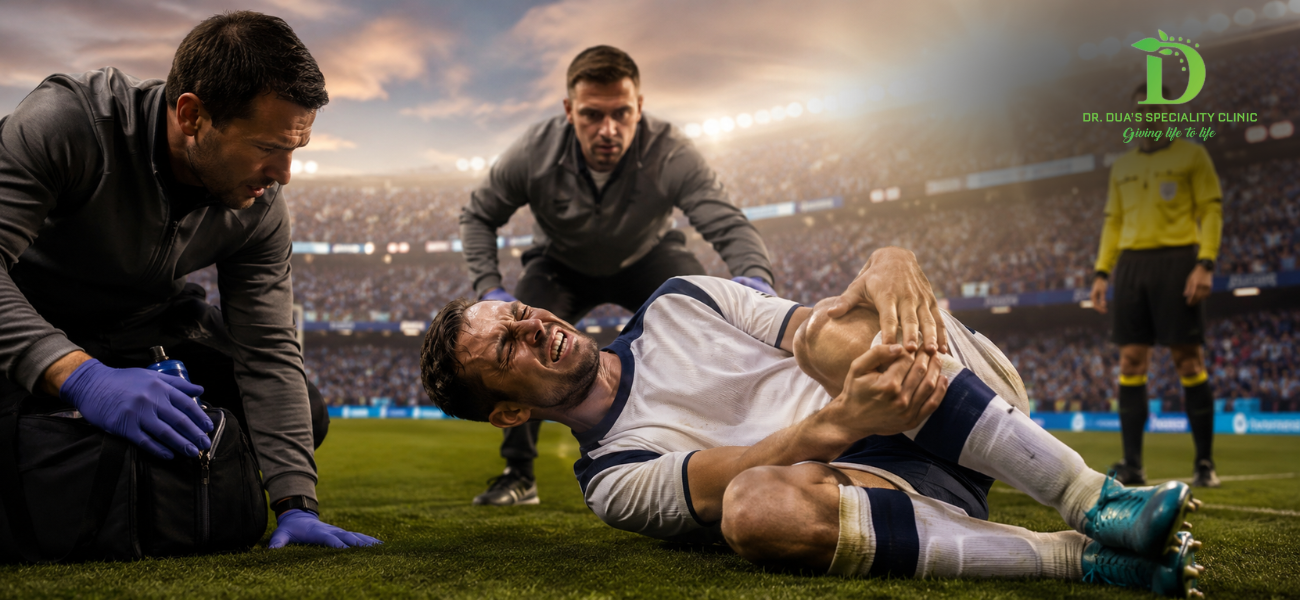
FIFA World Cup 2026 was supposed to be the biggest football festival on the planet — 48 teams, three host nations (USA, Canada, Mexico), and the world’s greatest players all on one stage.
But before a single ball was kicked, something alarming was already happening on the sidelines.
Rodrygo (Brazil) — out. Torn ACL. Xavi Simons (Netherlands) — out. Torn ACL. Kaoru Mitoma (Japan) — out. Hamstring tear. Eder Militao (Brazil) — out. Hamstring, needs surgery. Matthijs de Ligt (Netherlands) — out. Back surgery.
The list kept growing. By the time squads were finalised in June 2026, more than 20 high-profile players had been ruled out of the tournament — most of them due to three specific injuries: ACL tears, hamstring strains, and back problems.
This is not just a football crisis. This is an orthopedic emergency — and it mirrors what millions of everyday people in India experience every year without the benefit of world-class medical teams or rapid diagnosis.
In this blog, we break down exactly what these injuries are, why they keep happening, what the science says about treatment and recovery, and how you can protect yourself — with expert orthopedic guidance from Dr. Apoorv Dua, one of Delhi’s leading sports injury specialists.
Before we go into the medical details, let us look at the real data from this World Cup.
Player | Country | Injury | Status |
Rodrygo | Brazil | Torn ACL + Meniscus | Out |
Xavi Simons | Netherlands | Torn ACL | Out |
Jerdy Schouten | Netherlands | Torn ACL | Out |
Takumi Minamino | Japan | Torn ACL | Out |
Samu Aghehowa | Spain | Torn ACL | Out |
Marcelo Flores | Canada | Torn ACL | Out |
Levi Colwill | England | ACL tear (returned late) | Not selected |
Estêvão | Brazil | Hamstring strain | Out |
Eder Militao | Brazil | Hamstring, needs surgery | Out |
Kaoru Mitoma | Japan | Hamstring tear | Out |
Mohamed Salah | Egypt | Hamstring tear | Recovered, playing |
Lamine Yamal | Spain | Hamstring injury | Available (managed) |
Alphonso Davies | Canada | Hamstring, recovering | Doubtful opener |
Matthijs de Ligt | Netherlands | Back surgery | Out |
Marc-André ter Stegen | Germany | Thigh/back issue | Not selected |
Patrick Agyemang | USA | Torn Achilles | Out |
Hugo Ekitike | France | Torn Achilles | Out |
Billy Gilmour | Scotland | Knee injury | Out |
Key Stat: At the 2022 FIFA World Cup in Qatar, official data showed 82 time-loss injuries among participating players. Hamstring muscle injuries alone accounted for 19% of all injuries and had the highest injury burden — 26.7 days lost per 1,000 hours of play. In 2026, those numbers are trending even higher.
Another study by insurance group Howden found that after the 2022 World Cup, hamstring injuries in Europe’s top leagues rose by 130% in the post-tournament period, with players spending an average of 8 extra days on the sidelines compared to pre-tournament timelines.
This is the scale of the problem.
The ACL — Anterior Cruciate Ligament — is a band of tough tissue inside your knee that connects the thigh bone (femur) to the shin bone (tibia). It keeps your knee stable when you run, jump, pivot, or suddenly change direction.
In football, those movements happen hundreds of times per game. That is why football players are at extremely high risk.
An ACL tear does not always need a tackle or a collision. In many cases, it is a non-contact injury — the player lands awkwardly from a jump, twists while changing direction, or decelerates too fast.
Xavi Simons tore his ACL in April 2026 during a Premier League match — not from a tackle, but simply during play.
Rodrygo’s ACL tear, also combined with a meniscus injury, required surgery that ruled him out for months.
Treatment depends on the severity of the tear.
Grade 1 (Mild Sprain): Ligament is stretched but not torn. Rest, ice, compression, and physiotherapy. Recovery: 2 to 4 weeks.
Grade 2 (Partial Tear): Some fibres are torn. Extended rest, bracing, and guided rehabilitation. Recovery: 6 to 12 weeks.
Grade 3 (Complete Tear): The ligament is fully ruptured. This almost always requires ACL reconstruction surgery.
During ACL reconstruction, the torn ligament is replaced with a graft — tissue taken from the patient’s own body (patellar tendon, hamstring tendon) or from a donor. The procedure is done arthroscopically, meaning it is minimally invasive with small incisions.
Recovery timeline after ACL surgery:
A 2025 meta-analysis published in the journal Knee Surgery, Sports Traumatology, Arthroscopy confirmed that the majority of elite athletes do return to pre-injury performance levels — but the journey requires patience and professional guidance.
According to research from the University of Missouri, treatment typically requires surgery and at least 9 months of recovery, and some players never return to their previous level.
A 2025 study found that after ACL reconstruction, 37% of knees develop osteophytes (bone spurs) and 23% show joint space narrowing within 10 years — early signs of arthritis. This means untreated or poorly rehabilitated ACL injuries can lead to long-term knee problems even after recovery.
This is why choosing the right surgeon from the start matters enormously.
The hamstrings are three muscles at the back of your thigh — the biceps femoris, semitendinosus, and semimembranosus. They work together to help you run, kick, and decelerate.
In modern football, which demands explosive sprints, sudden stops, and powerful kicks, the hamstring is under enormous strain in every single game.
According to an 8-season study covering 3,909 players from 54 teams across 20 countries, hamstring injuries rose from 12% of all injuries in 2012 to 24% by 2022 — they have doubled in a decade. They now account for up to 24% of all football injuries.
Research also shows that approximately 1 in 5 professional footballers suffers a hamstring injury in a full season, and 1 in 3 of those injuries will recur.
Grade 1 (Mild): A few muscle fibres torn. Pain at the back of the thigh. Recovery: 8 to 10 days.
Grade 2 (Moderate): Around 50% of fibres torn. Visible bruising, pain when walking. Recovery: 3 to 8 weeks.
Grade 3 (Severe): More than 50% of fibres damaged. Sometimes requires surgery. Recovery: 1 to 3 months.
The recurrence rate for hamstring injuries is alarmingly high. Studies show most relapses happen within the first two months of returning to sport. The average time to return to competition is 17 days — and players often come back too soon.
Fixture congestion is a major driver. Research shows that when footballers play matches with less than 72 hours of recovery time between them, the risk of hamstring injury increases dramatically. In England’s Premier League alone, injury-related absences have increased by 11% per season in recent years.
Back problems in football do not get as much attention as ACL tears or hamstring injuries, but they can be equally devastating — and sometimes more complicated.
Matthijs de Ligt (Netherlands) is one of Europe’s finest defenders. He required back surgery and missed the entire World Cup. Marc-André ter Stegen (Germany), the Barcelona and Germany goalkeeper, also had a back-related issue and was not selected — Germany recalled Manuel Neuer from retirement to cover the gap.
These are not ordinary players. These are the best in the world. And they could not play.
Disc Herniation (Slipped Disc): The soft cushion between two vertebrae bulges or ruptures, pressing on nerves. Causes radiating pain down the leg (sciatica), numbness, and weakness.
Lumbar Muscle Strain: Overstretching of the lower back muscles — extremely common in players who twist repeatedly or take heavy challenges from behind.
Stress Fractures (Spondylolysis): Small cracks in the vertebral bones due to repeated stress. Common in young footballers and athletes.
Facet Joint Problems: Wear and tear of the small joints connecting vertebrae — causes chronic lower back pain and stiffness.
Not every back injury needs surgery. Most are treated conservatively — rest, physiotherapy, pain management, and core strengthening.
Surgery is considered when:
De Ligt’s case is a reminder that even world-class athletes sometimes need surgical intervention — and the earlier a diagnosis is made, the better the outcome.
Here is the part that concerns you directly.
The same injuries sidelining Rodrygo, Mitoma, and de Ligt are walking into orthopedic clinics in Delhi every single day — in people who play cricket on weekends, run in the morning, go to the gym, or simply slip on a wet floor.
ACL tears do not discriminate. A 28-year-old weekend footballer in Vasant Kunj is as vulnerable as Rodrygo.
Hamstring tears happen to gym-goers who do not warm up properly, runners who increase their mileage too fast, and people who suddenly sprint for a bus.
Back injuries affect desk workers, delivery drivers, and anyone who lifts improperly — not just elite athletes.
The difference is this: Rodrygo has an entire medical team that diagnosed his injury within hours, performed surgery within days, and began a structured rehabilitation programme immediately.
Most people in Delhi wait weeks before getting the right diagnosis. They try home remedies. They apply pain balm. They rest and hope it gets better. And often, a minor injury becomes a chronic problem.
RICE Protocol (Rest, Ice, Compression, Elevation): First-line treatment for acute injuries. Effective for Grade 1 sprains and mild strains.
Physiotherapy: Targeted exercise programmes to strengthen the muscles around the injured joint, improve flexibility, and prevent recurrence. Essential for both surgical and non-surgical cases.
GFC Therapy (Growth Factor Concentrate): An advanced non-surgical treatment that uses concentrated growth factors from the patient’s own blood to accelerate tissue repair and reduce inflammation. Effective for mild to moderate tendon and ligament injuries, and increasingly popular as an alternative to surgery in suitable cases.
PRP (Platelet-Rich Plasma) Injections: Similar in principle to GFC, PRP injections promote natural healing at the injury site. Useful for hamstring tendinopathy, early ACL sprains, and joint inflammation.
ACL Reconstruction: The gold standard for complete ACL tears. The procedure replaces the torn ligament with a graft using arthroscopic (keyhole) technique. Modern arthroscopic surgery means smaller incisions, faster recovery, and less post-operative pain compared to open surgery.
Meniscus Repair: When the ACL injury involves the meniscus (knee cartilage), repair or partial removal may be needed. Preserving the meniscus is always the preferred approach as it protects the knee from long-term arthritis.
Hamstring Surgery: Severe Grade 3 hamstring tears or proximal hamstring avulsions (where the tendon pulls away from the bone) may need surgical reattachment.
Spine Surgery: For disc herniations, spinal stenosis, or fractures that do not respond to conservative treatment, minimally invasive spine procedures can provide significant relief.
Surgery is only half the battle. The other half is rehabilitation — and it is the half that determines whether you return to full function or develop a chronic problem.
Post-ACL Surgery Rehabilitation (General Phases)
Post-Hamstring Injury Rehabilitation
Post-Back Surgery Rehabilitation
The best sports injury is the one that never happens.
Here are evidence-based steps to protect your knees, hamstrings, and back:
When you talk about the kind of injuries devastating FIFA World Cup 2026 — ACL tears, hamstring problems, back surgeries — you need a specialist who understands not just the anatomy, but the lifestyle, recovery goals, and emotional impact of a sports injury.
Dr. Apoorv Dua is one of Delhi’s most trusted orthopedic surgeons, based at Dr. Dua’s Speciality Clinic, Greater Kailash II, New Delhi.
What makes Dr. Dua uniquely qualified to treat sports injuries?
He holds a FIFA Diploma in Football Medicine from Switzerland — the same certification used by the medical teams that treat the players you are watching at the World Cup. This is not a generic orthopedic degree. It is a specialised qualification in the exact type of sports injuries dominating global headlines right now.
His qualifications include:
With over 12 years of experience and more than 70,000 patients treated, Dr. Dua offers the full spectrum of sports injury care — from non-surgical options like GFC Therapy and PRP injections to advanced arthroscopic ACL reconstruction and meniscus repair.
A patient who underwent meniscus repair surgery with Dr. Dua wrote: “Dr. Apoorv took a more thoughtful, patient-first approach. He initially tried non-surgical management… when symptoms did not improve, he advised a meniscus repair rather than removing the meniscus, prioritising long-term knee health. I am now four months post-op with full range of motion.”
This is precisely the approach elite players and everyday athletes both deserve — conservative where possible, surgical where necessary, always focused on long-term outcomes.
📍 Dr. Dua’s Speciality Clinic M-85, 80 Feet Road, Block M, Greater Kailash II, New Delhi – 110048 📞 +91-9034333133 🕘 Mon–Sat: 9 AM to 7 PM
👉 WhatsApp to Book: Click here to book your appointment on WhatsApp
FAQ 1: How many players have been ruled out of FIFA World Cup 2026 due to injury?
As of early June 2026, more than 20 high-profile players have been confirmed absent from the tournament due to injuries. These include Rodrygo and Eder Militao (Brazil), Xavi Simons and Jerdy Schouten (Netherlands), Kaoru Mitoma and Takumi Minamino (Japan), Matthijs de Ligt (Netherlands), Patrick Agyemang (USA), and many others. ACL tears and hamstring injuries are the two most common injury types leading to absences.
FAQ 2: Why is the ACL the most commonly injured ligament in football?
The ACL is under constant stress in football because it stabilises the knee during the rapid pivots, sudden direction changes, and explosive sprints that the game demands. It can tear during contact (a tackle or collision) or even without contact — a bad landing from a jump or an awkward twist at speed is enough. In 2026, multiple players including Rodrygo, Xavi Simons, and Jerdy Schouten all sustained ACL tears before the World Cup.
FAQ 3: How long does ACL surgery recovery take?
Full recovery from ACL reconstruction surgery typically takes 9 to 12 months for a return to competitive sport. The surgery itself is done arthroscopically and takes about 1 to 2 hours. The longer timeline is for rehabilitation — rebuilding muscle strength, restoring joint stability, and progressively returning to sport-specific movements. Rushing this process significantly increases the risk of re-injury.
FAQ 4: Can an ACL tear heal without surgery?
A complete (Grade 3) ACL tear generally does not heal without surgery — the ligament cannot repair itself because of limited blood supply. However, not every ACL injury requires surgery. Partial tears and mild sprains can sometimes be managed conservatively with physiotherapy and bracing, particularly in less active individuals. The decision depends on the extent of the tear, the patient’s age, activity level, and goals. A qualified orthopedic surgeon should make this assessment.
FAQ 5: What is the difference between a hamstring strain and a hamstring tear?
A hamstring “strain” and a hamstring “tear” are essentially the same thing — it is the degree of damage that differs. A Grade 1 strain means a few muscle fibres are overstretched or mildly torn — recovery in 8 to 10 days. A Grade 2 involves a more significant partial tear — recovery in 3 to 8 weeks. A Grade 3 means more than 50% of the muscle fibres are damaged, sometimes with complete rupture — recovery can take 1 to 3 months and may need surgery.
FAQ 6: Why do hamstring injuries keep coming back?
Hamstring re-injuries happen for several reasons: returning to play too soon before the muscle has fully healed, muscle imbalance between hamstrings and quadriceps, inadequate rehabilitation, and insufficient warm-up. Research shows about 1 in 3 hamstring injuries recur, most within the first two months of returning to sport. A structured rehabilitation programme that includes eccentric strengthening exercises is the most effective way to reduce recurrence.
FAQ 7: What is GFC Therapy and is it used for sports injuries?
GFC stands for Growth Factor Concentrate. It is an advanced regenerative treatment where a concentrated solution of growth factors is prepared from the patient’s own blood and injected into the injured site — a tendon, ligament, or joint. These growth factors accelerate natural tissue repair, reduce inflammation, and promote healing. GFC Therapy is increasingly used for hamstring tendinopathy, early-stage ACL sprains, rotator cuff injuries, and knee cartilage problems. It is a non-surgical option that avoids the risks and recovery time of an operation.
FAQ 8: When should I see a doctor after a knee injury — and not just rest at home?
You should see an orthopedic specialist immediately if:
Delayed diagnosis of an ACL tear or other knee injury can lead to additional damage to the meniscus, cartilage, and other structures — making treatment more complex and recovery longer.
FAQ 9: Can normal people (non-athletes) get ACL or hamstring injuries?
Absolutely. ACL tears happen to people playing recreational football, basketball, badminton, and even to those who miss a step on the stairs or twist their knee getting out of a car. Hamstring injuries are common among gym-goers, runners, and anyone who does physical activity without proper warm-up or conditioning. The injury is not about being elite — it is about the forces placed on the body relative to its preparation.
FAQ 10: Is it safe to play through minor knee or back pain during sport?
Playing through pain is rarely safe and almost always makes the underlying problem worse. Minor pain is the body’s early warning system — it signals that something is being strained or stressed beyond its limit. A small hamstring tightness that is ignored can become a Grade 2 tear. A vague knee ache that is pushed through can accelerate cartilage damage. The correct approach is always to get a proper assessment, identify the cause, and make an informed decision about when and how to return to activity.
FIFA World Cup 2026 will be remembered for its drama, its goals, and its champions. But it will also be remembered as a tournament that arrived carrying one of the most significant injury crises in football history — dozens of players taken down by ACL tears, hamstring injuries, and back problems before they could even take the field.
These injuries are not just a problem for elite footballers. They are conditions that affect millions of people every year — in gyms, on cricket grounds, on morning runs, and sometimes just in daily life.
The good news is that with the right diagnosis, the right treatment, and the right rehabilitation, most people recover fully and return to the activities they love.
If you are dealing with knee pain, hamstring tightness, back discomfort, or any sports-related injury — do not wait. The earlier the intervention, the better the outcome.
Dr. Apoorv Dua brings FIFA-certified sports medicine expertise, advanced arthroscopic surgical skills, and a patient-first philosophy to every case. From GFC Therapy for those who want to avoid surgery to ACL reconstruction for those who need it — the full spectrum of care is available at Dr. Dua’s Speciality Clinic, Greater Kailash II.
📞 Call: +91-9034333133 👉 Book on WhatsApp

Dr Apoorv is one of the best orthopaedic surgeons in South Delhi. There are multiple streams of medical sciences in which he has a specialisation. Some of the major areas are Hip, Knee and Shoulder Replacement and Reconstruction, FIFA Diploma in Football Medicine (Switzerland), IFICS Fellowhip in Paediatric fractures.
Dr Apoorv Dua Clinic © 2026 | Designed by Artistry Media