

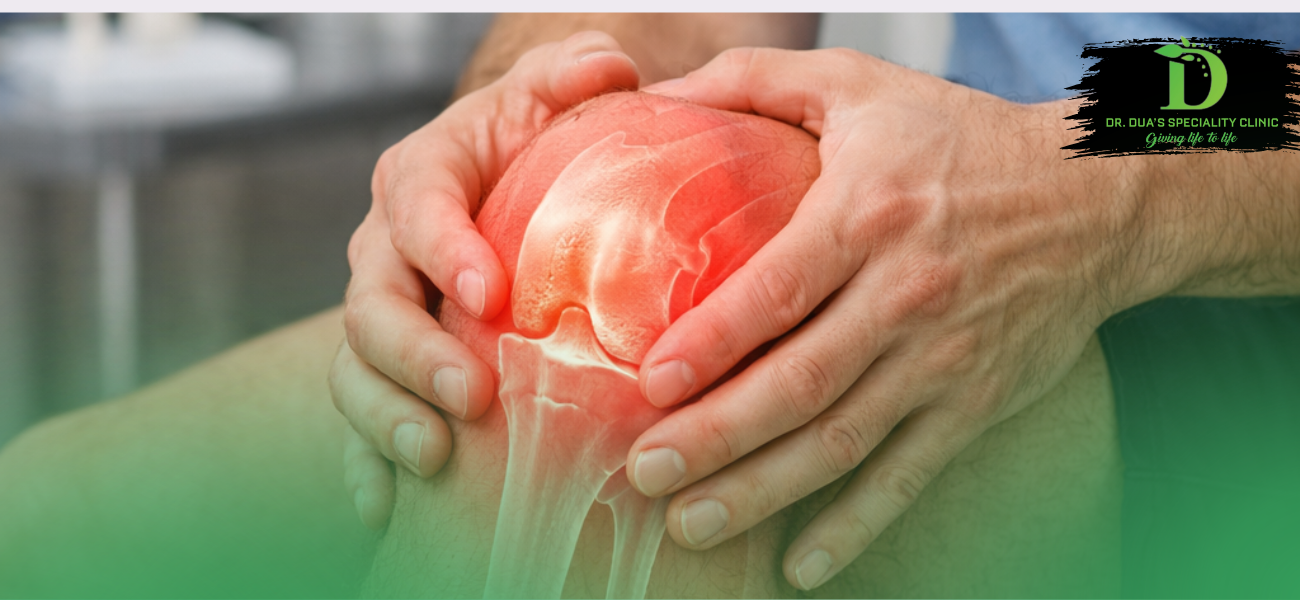
Sometimes knee pain comes slowly, and sometimes it suddenly becomes worse. You may be walking normally, going down stairs, or simply standing up—and suddenly a sharp pain starts in your knee. Most people get confused in this situation: “Is this normal? Is it arthritis? Did I get a fracture? Will I need surgery now?”
The truth is that not every knee pain ends in surgery. In 2026, non-surgical treatment options for knee pain have become quite advanced, and with the right diagnosis, many patients get relief without surgery. But the most important thing is that ignoring knee pain can also be risky, especially when the pain suddenly gets worse.
In this blog, we will understand 7 warning signs that show knee pain may be serious, and then we will explore in detail the best knee pain treatment without surgery—such as physiotherapy, lifestyle correction, medicines, PRP injection for knee pain, and GFC treatment for knee pain.
Why Knee Pain Suddenly Gets Worse
The knee joint is a complex structure. It has cartilage that works like cushioning, a meniscus that behaves like a shock absorber, ligaments that provide stability, and muscles that support the knee. When any of these parts develops inflammation, injury, wear-and-tear, or imbalance, knee pain begins.
There are a few common reasons why knee pain suddenly becomes worse. Sometimes there is a meniscus tear, sometimes a ligament sprain, sometimes an arthritis flare-up, and sometimes fluid builds up inside the knee. In some cases, infection or problems like gout can also be the reason.
Sudden pain does not always mean surgery is confirmed, but it does mean you should identify the cause properly.
7 Warning Signs You Should Not Ignore
A certain level of knee pain can be normal fatigue, but some symptoms are red flags. If you notice any of these signs, you should not delay.
1) Knee Swelling That Appears Quickly
If swelling appears suddenly in the knee, especially within a single day, it may be a sign of injury or inflammation. Swelling is common in meniscus tears, ligament injuries, or synovitis. Swelling can also mean that fluid is collecting inside the knee joint.
2) Pain While Walking or Climbing Stairs
Knee pain while walking and knee pain while climbing stairs are both common symptoms. But when the pain suddenly becomes intense, it can be a sign of cartilage wear, patellofemoral pain syndrome, or early arthritis.
3) Knee Locking or Feeling Stuck
If your knee does not bend properly or feels “locked,” it strongly suggests a meniscus tear. This is an important warning sign because locking restricts movement and increases the risk of further damage.
4) Knee Giving Way (Instability)
If your knee feels like it is “giving way” while walking, or it feels like the knee is not supporting you, it may be due to a ligament injury (ACL/PCL) or muscle weakness. Ignoring instability is not safe.
5) Pain at Night or Pain Even at Rest
If you have knee pain at night, or you feel pain even while resting, it may be a sign of inflammation, an arthritis flare, or nerve-related pain. Severe night pain requires medical consultation.
6) Knee Pain After a Twist or Sudden Movement
Sometimes just one twist, one wrong step, or a sudden movement can trigger knee pain. The cause may be a meniscus injury, ligament sprain, or cartilage damage.
7) Pain With Fever, Redness, or Warmth
If knee pain comes with fever, redness, or the joint feels warm, there may be a possibility of infection. This can be an urgent condition, and delay can be dangerous.
The Most Common Causes of Knee Pain
Understanding the causes of knee pain is important because treatment is decided based on the cause.
Arthritis is the most common cause, especially in the 40+ age group. In arthritis, cartilage gradually wears down and knee stiffness and pain increase. But apart from arthritis, meniscus tears, ligament injuries, patella tracking problems, tendon inflammation, obesity-related stress, vitamin D deficiency, and muscle weakness can also be major reasons for knee pain.
Many times, patients think they have arthritis, but the actual issue is a meniscus tear. That is why avoiding self-diagnosis is best.
Knee Pain Treatment Without Surgery: What Really Works in 2026
Now the most important part: knee pain relief without surgery.
Today, the main goal of non-surgical knee pain treatment is pain control, reducing inflammation, improving stability, and protecting the joint. Treatment is not the same for every patient because the reason for knee pain can be different.
1) Correct Diagnosis (Most Important Step)
The foundation of knee pain treatment is diagnosis. It is important to know whether your pain is due to arthritis or a meniscus injury. Usually, the doctor performs a physical examination and, if needed, recommends an X-ray or MRI.
X-ray mainly shows arthritis and joint space narrowing, while MRI shows detailed information about the meniscus, ligaments, and cartilage.
2) Lifestyle Changes That Actually Reduce Knee Pain
This may sound boring, but lifestyle correction is the most effective long-term step for knee pain. If your weight is high, the pressure on the knee joint becomes much greater. Weight reduction naturally reduces pain.
Footwear is also important. Hard soles and flat slippers can worsen knee pain. Supportive shoes and cushioning can give relief to the knee joint.
Sitting posture, stair usage, and long standing can also trigger knee pain.
3) Physiotherapy: The Real Foundation
Physiotherapy for knee pain is the most proven treatment. Its goal is to strengthen the muscles that support the knee, especially the quadriceps, hamstrings, and glutes.
Strong muscles reduce pressure on the knee joint. Physiotherapy improves stability, reduces pain, and lowers the risk of future injury.
A good physiotherapy plan is not only exercises—it also includes stretching, mobility work, balance training, and gait correction.
4) Medicines and Pain Management
Medicines can be helpful in the short term, especially for controlling inflammation. But long-term dependence on painkillers can create side effects. That is why medicines should be used as supportive treatment, not as the main solution.
5) Knee Braces and Support
A knee brace provides temporary support, especially when there is instability or pain while climbing stairs. In arthritis, unloading braces can also be helpful.
The role of a brace is pain control, but overuse can weaken muscles. That is why braces should be used smartly.
PRP Injection for Knee Pain: What It Is and Who It Helps
PRP stands for Platelet-Rich Plasma. It is prepared from the patient’s own blood. The blood is processed in a centrifuge to concentrate platelets, and then the plasma is injected into the knee joint.
The goal of PRP injection for knee pain is to reduce inflammation and support tissue healing. PRP can be beneficial in early arthritis, cartilage wear, tendon problems, and mild ligament injuries.
PRP does not work like an immediate painkiller. Usually, improvement starts in 2–6 weeks, and the full effect is felt in 2–3 months. Some patients feel relief with one injection, while others need multiple sessions.
PRP is not a magic solution for everyone. In advanced arthritis where cartilage is almost completely worn out, PRP response may be limited. But in early-stage patients, PRP is a strong option for knee pain relief without surgery.
GFC Treatment for Knee Pain: Why It’s Trending
GFC means Growth Factor Concentrate. It is also prepared from the patient’s blood, but it is more refined and concentrated compared to PRP. It contains a higher level of growth factors that boost the healing process.
GFC treatment for knee pain is trending in 2026 because it is considered a cleaner, more targeted, and often better-tolerated option compared to PRP. Many patients report faster comfort and better functional improvement, especially in early arthritis and chronic inflammation cases.
GFC is used in early stages of arthritis, cartilage degeneration, sports injury recovery, and chronic knee pain management. This treatment is non-surgical, and with proper case selection, good results can be achieved.
Can Knee Arthritis Be Treated Without Surgery?
This is a question almost every patient asks.
Answer: Yes, in many cases, knee arthritis treatment without surgery is possible, especially in early and moderate stages. A non-surgical approach combines physiotherapy, weight management, supportive braces, lifestyle correction, PRP/GFC injections, and a pain management plan.
Surgery is considered when pain becomes severe, daily walking becomes difficult, and X-ray shows that joint space is almost finished.
Today, the goal is to delay surgery and provide the patient with pain-free mobility.
What to Do Immediately When Knee Pain Suddenly Gets Worse
If your knee pain suddenly becomes worse, the first thing is not to panic. Some basic steps are safe.
Rest is important, but complete bed rest is not. Ice application can reduce swelling and pain. Elevating the knee can help. If swelling is high, a compression bandage can be used, but it should not be too tight.
If there is knee locking, instability, or severe swelling, medical consultation should not be delayed.
When You Should See an Orthopedic Specialist
The biggest risk in knee pain is that people ignore it for months. Then the problem becomes worse and recovery becomes slower.
You should consult an orthopedic specialist if pain is not improving in 7–10 days, swelling is repeating, climbing stairs becomes difficult, the knee is giving way, or pain is affecting daily life.
Dr. Apoorv Dua
In knee pain cases, the most important things are correct diagnosis and a personalized treatment plan. Dr. Apoorv Dua is an orthopedic specialist who evaluates knee pain patients based on causes such as arthritis, sports injury, cartilage wear, meniscus problems, and ligament injuries. Many patients are guided with physiotherapy-based plans and advanced options like PRP and GFC treatments to manage pain without surgery, so that they can get long-term relief and better mobility.
FAQs
1.Can PRP injection permanently cure knee pain?
PRP is not a permanent cure, but in early arthritis and inflammation cases, it can provide long-term relief and better function, especially when combined with physiotherapy and lifestyle changes.
2.What is the difference between GFC and PRP?
Both are blood-based regenerative treatments, but GFC is generally more refined and richer in growth factors, and in some cases it may give a better response than PRP.
3.When should I get an MRI for knee pain?
MRI is useful when the knee is locking, pain starts after a twisting injury, instability is present, or pain is not improving within 2–3 weeks.
4.When is surgery necessary for knee arthritis?
Surgery is considered when pain becomes severe, walking becomes limited, and X-ray shows that joint space is almost finished.
5.What is the best home remedy for knee pain?
Ice therapy, gentle stretching, supportive footwear, and weight control are the best home steps, but if pain is persistent, doctor consultation is necessary.
Final Thoughts
Knee pain suddenly getting worse can be a warning, but it does not mean surgery is confirmed. Today, non-surgical options for knee pain treatment are strong, and with the right diagnosis, physiotherapy, lifestyle correction, PRP injection for knee pain, and GFC treatment for knee pain can provide relief for many patients.
If your pain is repeating, swelling is present, or walking is affected, do not delay. Early action leads to faster recovery and reduces the risk of future damage.
