

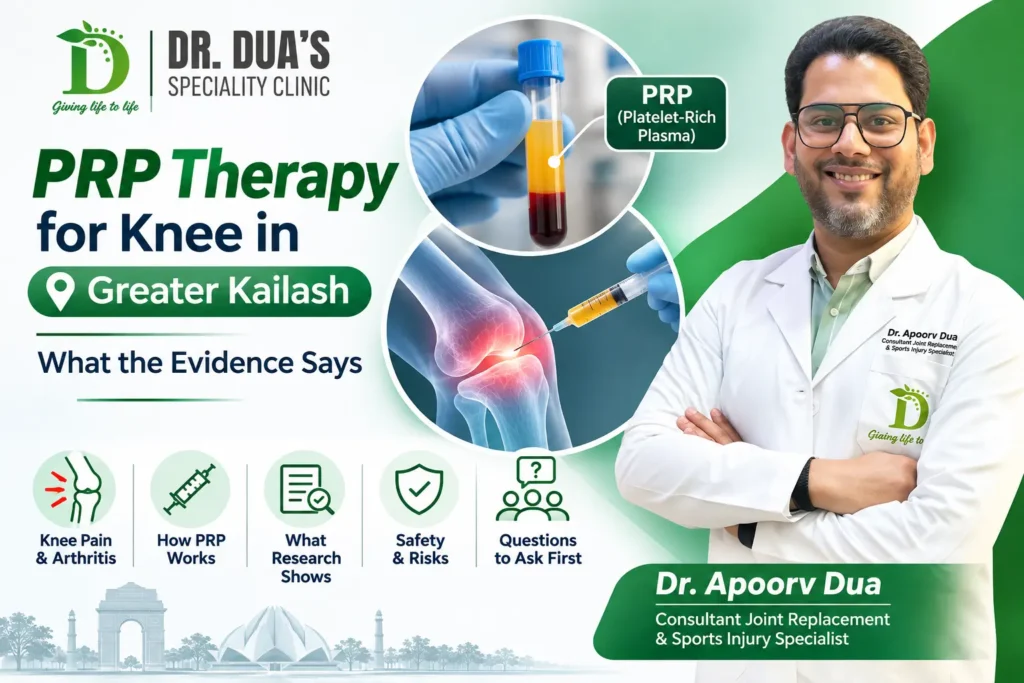
PRP Therapy for Knee in Greater Kailash: What the Evidence Says
By Dr. Apoorv Dua, Orthopedic Surgeon (MBBS, M.S. Orthopaedics; fellowships in joint replacement, ligament reconstruction, and shoulder arthroscopy and sports medicine), Dr. Dua’s Speciality Clinic, Greater Kailash II. Last updated: 6 November 2026.
Knee pain makes you try everything. Tablets, gels, hot packs, a new pair of shoes. Then a friend mentions an injection made from your own blood. So you search for PRP therapy for knee in Greater Kailash, and find big promises. This guide keeps it simple. It explains what PRP is, what research shows, who may benefit, and what to ask your doctor.
Quick answer: PRP (platelet-rich plasma) is made by spinning a small sample of your own blood and injecting the platelet-rich part into the knee. Research is mixed. A large 2021 trial found no benefit over saline for knee arthritis, while some patients still report relief. PRP is not a replacement for a proper diagnosis. Dr. Apoorv Dua at Dr. Dua’s Speciality Clinic, Greater Kailash II, can advise whether a non-surgical injection suits your knee.
What is PRP therapy for the knee?
Your blood carries platelets, tiny cells that help the body heal. For PRP, a nurse draws a small amount of blood. A machine then spins it to concentrate the platelets. Finally, the doctor injects this plasma into or around the painful knee. Because it comes from your own body, allergic reactions are less likely than with many other injections.
What does the research actually say?
Here, honesty matters. PRP is popular, yet the evidence is not simple.
In 2021, JAMA published a randomized trial of 288 adults over 50 with mild to moderate knee osteoarthritis. Half received three weekly PRP injections, and half received saline. At 12 months, knee pain fell by about the same amount in both groups. Cartilage change was also similar. You can read the trial abstract on PubMed.
That does not mean PRP never helps. Studies differ in how PRP is prepared, how many injections are given, and which patients are chosen. Still, you should know that the best-known trial found no advantage. A trustworthy doctor tells you this before you pay.
Who may consider PRP?
Your doctor may discuss PRP if you have:
- Mild to moderate knee arthritis that has not settled with exercise and medicines
- Pain that limits daily life, but surgery is not yet needed
- A wish to try a non-surgical option first, after hearing the evidence
It is usually not the answer for severely worn knees. In that case, read about knee replacement with Dr. Dua.
PRP therapy for knee in Greater Kailash: what to ask first
Before you agree to any injection, ask these questions:
- What is my exact diagnosis? An X-ray or MRI should confirm the cause of pain.
- Is PRP right for this problem? Arthritis, tendon pain and ligament injuries are different.
- What does the evidence say? Ask for a plain answer, including the doubts.
- How many injections will I need? Also ask how long relief might last.
- What is the full cost? Ask for it in writing.
- What is plan B? You should hear the alternatives.
PRP and GFC: what is the difference?
Dr. Dua’s clinic describes GFC therapy as a non-surgical option made from the patient’s own blood, using a closed system. It is related to PRP, but it is not the same product. The clinic’s page says GFC works better than PRP. However, it does not cite independent studies for this. So, ask Dr. Dua which option, if any, suits your knee, and what evidence supports it. Please do not assume that one name is automatically better.
What happens during the procedure?
- The doctor examines your knee and reviews your scans.
- A small blood sample is drawn from your arm.
- The blood is processed in a centrifuge.
- The doctor cleans the skin and injects the plasma into the knee, often with ultrasound guidance.
- You rest briefly and go home the same day.
Some soreness for a day or two is common. Avoid heavy exercise until your doctor allows it.
Is PRP therapy for knee in Greater Kailash right for you?
Only an examination can answer that. Two people with “knee pain” may have very different problems. One may have early arthritis. The other may have a small tendon strain. In addition, age, weight, activity and earlier treatment all matter. So, avoid choosing PRP only because a friend did. Instead, start with a diagnosis, then compare options calmly.
Also, keep your expectations realistic. Many patients who benefit from any injection still need exercise and weight control to keep the gain. Therefore, treat an injection as one part of a plan, not the whole plan.
Cost and transparency
Ask for a clear written estimate before any procedure. It should state the price per injection, the number of sessions advised, and what is included. Meanwhile, be careful with packages that promise cure. A doctor who explains the limits is usually the one to trust.
Risks and limits
PRP is generally considered low-risk. Even so, an injection can cause pain, swelling, bleeding or, rarely, infection. Call your doctor if the knee becomes hot, red or very painful, or if you get a fever. Also remember the limits. PRP will not regrow a worn joint. It will not fix a torn ligament or a locked knee either.
Other treatments to consider
- Exercise and physiotherapy: strengthening the thigh muscles helps most knees. See our rehabilitation page.
- Weight control: every kilo lost takes load off the knee
- Medicines and other injections: as your doctor advises
- Ligament or meniscus repair: see ACL and PCL surgery and the sports injury centre
- Replacement: for severe damage, when daily life suffers
For a wider look at knee care, read our guide to an orthopedic specialist for knee in Greater Kailash.
About Dr. Apoorv Dua
Dr. Apoorv Dua is an orthopedic surgeon with an MBBS and M.S. in Orthopaedics. His training includes a fellowship in joint replacement and ligament reconstruction in Germany, and an IOA fellowship in shoulder arthroscopy and sports medicine. He also holds a FIFA Diploma in sports medicine. Read his full profile or see patient testimonials.
Clinic address: Dr. Dua’s Speciality Clinic, M-85, M Block, 80 Feet Road, Greater Kailash II, New Delhi 110048. OPD runs Monday to Saturday, 9 AM to 7 PM. Patients also visit from Chittaranjan Park, Lajpat Nagar, Defence Colony and Nehru Place.
Frequently asked questions
Is PRP therapy for knee available in Greater Kailash?
Dr. Dua’s clinic lists GFC therapy, a related blood-based treatment. Please call to ask whether PRP or GFC suits your knee.
Does PRP really work for knee arthritis?
Evidence is mixed. A 2021 JAMA trial found no benefit over saline at 12 months, though other studies and patients report relief.
Who should consider PRP therapy for knee in Greater Kailash?
Mostly people with mild to moderate arthritis who want a non-surgical option and understand the evidence. Your doctor decides after examination.
Is PRP safe?
It uses your own blood, so allergy is unlikely. Pain, swelling and, rarely, infection can occur.
How many PRP injections are needed?
It varies. Your doctor will explain the plan, and how long relief may last.
Can PRP help a torn ligament or meniscus?
Not reliably. Many tears need examination, MRI and sometimes surgery.
How do I book a consultation?
Use the appointment page or call +91-9034333133.
Knee pain that keeps coming back? Book a consultation with Dr. Apoorv Dua in Greater Kailash II.
