
Orthopaedic Clinic in Greater Kailash: What to Look For and What to Expect
By Dr. Apoorv Dua, Orthopaedic Surgeon (MBBS, M.S. Orthopaedics; fellowships in joint replacement and ligament reconstruction, arthroplasty, and shoulder arthroscopy with sports medicine), Dr. Dua’s Speciality Clinic, Greater Kailash II. Last updated: 26 October 2026.
An orthopaedic clinic in Greater Kailash should make your life easier, not harder. You walk in with a painful knee or a stiff shoulder. You want a clear diagnosis, a plan you understand and a doctor who has time for you. This guide explains what a good clinic offers, and how to judge one before you book.
Quick answer: A good orthopaedic clinic offers a trained orthopaedic surgeon, proper examination, on-site guidance for tests, both non-surgical and surgical options, and a rehabilitation plan. Dr. Dua’s Speciality Clinic in Greater Kailash II treats joint replacement, sports injuries, shoulder problems and fractures, with OPD from Monday to Saturday, 9 AM to 7 PM.
What does an orthopaedic clinic treat?
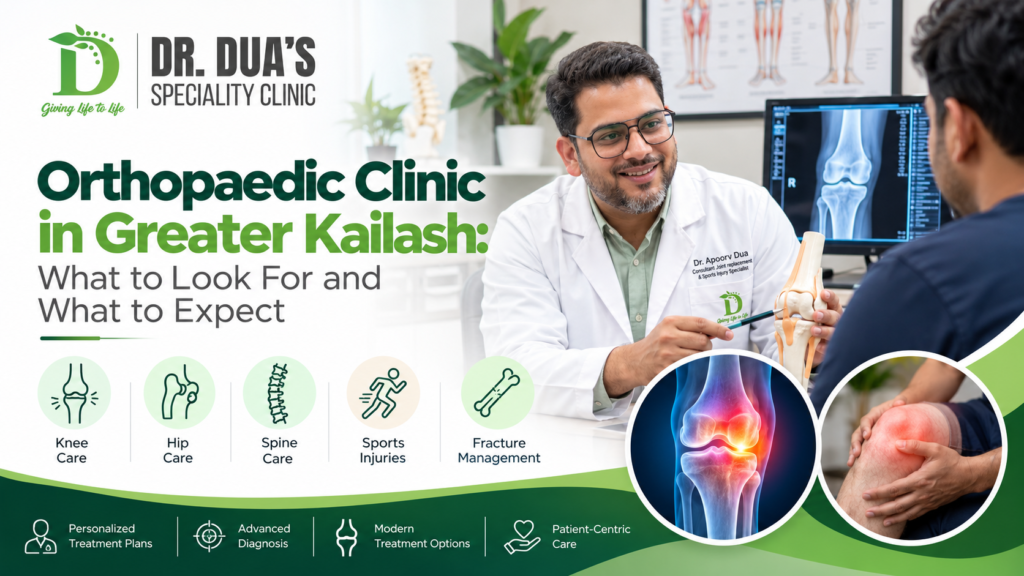
Orthopaedics deals with bones, joints, ligaments, tendons and muscles. A full-service clinic should help with everyday aches and also with complex surgery. At Dr. Dua’s clinic, the main areas are:
- Knee replacement, including minimally invasive options
- Hip replacement and shoulder replacement
- ACL and PCL ligament surgery
- Rotator cuff repair and frozen shoulder treatment
- Sports injuries
- GFC therapy for selected joint problems
- Fracture and trauma care
The clinic also treats pain in the foot and ankle and the elbow.
What makes a good orthopaedic clinic in Greater Kailash?
Shiny waiting rooms do not heal bones. Instead, check these points before you book.
- The surgeon’s training. Look for an M.S. in orthopaedics and fellowships in your problem area.
- Time for examination. A doctor who examines you carefully finds problems that scans can miss.
- Non-surgical options first. Medicines, exercise and injections should be discussed before surgery.
- Surgical skill when needed. The same doctor should be able to operate if your problem needs it.
- Rehabilitation. Recovery needs a plan, not just advice to “rest”.
- Clear costs and follow-up. You should know what the treatment includes.
Meet the surgeon behind the clinic
Dr. Apoorv Dua trained in orthopaedics in Mumbai and completed a fellowship in joint replacement and ligament reconstruction in Germany. He also has a fellowship in arthroplasty surgery, an IOA Inland Fellowship in Shoulder Arthroscopy and Sports Medicine from Ganga Hospital, a FIFA Diploma from Switzerland and an IFICS fracture fellowship.
This mix matters for patients. For example, one visit can cover a worn hip, a torn ligament and an old fracture, because training spans all three. Read his full profile and hear from patients.
Not every problem needs surgery
Many people fear that an orthopaedic clinic will always suggest an operation. In reality, a large share of joint pain improves without it. Weight management, strengthening, physiotherapy and medicines help many patients. In selected cases, injection-based treatments such as GFC may be considered after assessment.
Surgery becomes the right answer when a joint is badly worn, a ligament is torn in an active person, or a bone has not aligned. Your doctor should show you the scan, explain the choices and let you decide. Also, if you want a second opinion, take it.
Why joint problems are rising
Joint pain is no longer just an old-age problem. The World Health Organization estimates that about 528 million people lived with osteoarthritis in 2019, and the knee was the joint most often affected. Long hours of sitting, extra weight, past injuries and weak muscles all add to the risk.
For example, desk workers in South Delhi often develop stiff necks and hips. Similarly, weekend sports players often tear ligaments. Both groups do better when they see a doctor early. You can read more in our posts on knee pain treatment in South Delhi and sports injury treatment.
Sports injuries and weekend athletes
Many patients at an orthopaedic clinic in Greater Kailash are active people. They play badminton, cricket, football or run in the park. When they get hurt, they often wait. However, a torn ligament or cuff can worsen if you keep playing.
See a doctor early if you hear a pop during a game, if the joint swells quickly or if it feels unstable. Also seek help when pain lingers after a week of rest. Early diagnosis means a shorter recovery. As a result, you return to the game sooner and with less risk of a repeat injury.
Red flags that need a doctor now
- A joint that looks bent or out of place
- Severe pain after a fall, with no ability to bear weight
- Fever with a hot, swollen joint
- Numbness, tingling or weakness that spreads
In such cases, go to the nearest emergency room first. Then visit your orthopaedic surgeon for follow-up care.
What to expect at your first visit
- Your story. The doctor asks how the pain began and how it affects daily life.
- Physical examination. He checks movement, strength, stability and swelling.
- Tests, only if needed. X-ray, ultrasound or MRI are advised when they will change the plan.
- Explanation of options. You hear both non-surgical and surgical paths.
- A written plan. You leave knowing the next step, the timeline and the follow-up.
Please bring old reports, scans and a list of medicines. Because they help the doctor avoid repeat tests, they also save you money.
Rehabilitation: the part most people skip
Even the best operation fails without good rehab. That is why the clinic has a dedicated rehabilitation programme. It helps you move safely, rebuild strength and return to work or sport. In contrast, patients who skip exercises often stay stiff and weak for months.
Clinic location and timings
Dr. Dua’s Speciality Clinic is at M-85, M Block, 80 Feet Road, Greater Kailash II, New Delhi 110048. OPD runs Monday to Saturday, 9 AM to 7 PM, and the clinic is closed on Sunday. Patients also come from Chittaranjan Park, Nehru Place, Kailash Colony and Lajpat Nagar. Take a look at the clinic gallery and read other articles on the blog.
The bottom line
Pick an orthopaedic clinic in Greater Kailash that listens first and treats second. Look for training you can verify, honest advice and a recovery plan. Because good care takes time, choose a doctor you feel comfortable meeting again.
Frequently asked questions
How do I choose an orthopaedic clinic in Greater Kailash?
Check the surgeon’s qualifications, how thoroughly they examine you, whether they discuss non-surgical options and what rehabilitation support they offer.
What conditions does an orthopaedic clinic treat?
It treats problems of bones, joints, ligaments, tendons and muscles, such as arthritis, fractures, sports injuries, shoulder pain and joint replacement needs.
Do I need a referral to see an orthopaedic surgeon?
No. You can book directly with the clinic.
Is surgery always recommended?
No. Many problems improve with exercise, medicines and physiotherapy. Surgery is advised only when other treatment will not help.
What are the clinic timings?
The OPD is open Monday to Saturday from 9 AM to 7 PM. It is closed on Sunday.
Does the clinic treat sports injuries?
Yes. Dr. Dua has training in sports medicine and ligament reconstruction, and treats injuries such as ACL tears and rotator cuff tears.
How do I book an appointment?
Use the appointment page or call +91-9034333133.
Pain getting in the way? Book a consultation at Dr. Dua’s Speciality Clinic in Greater Kailash II.
