

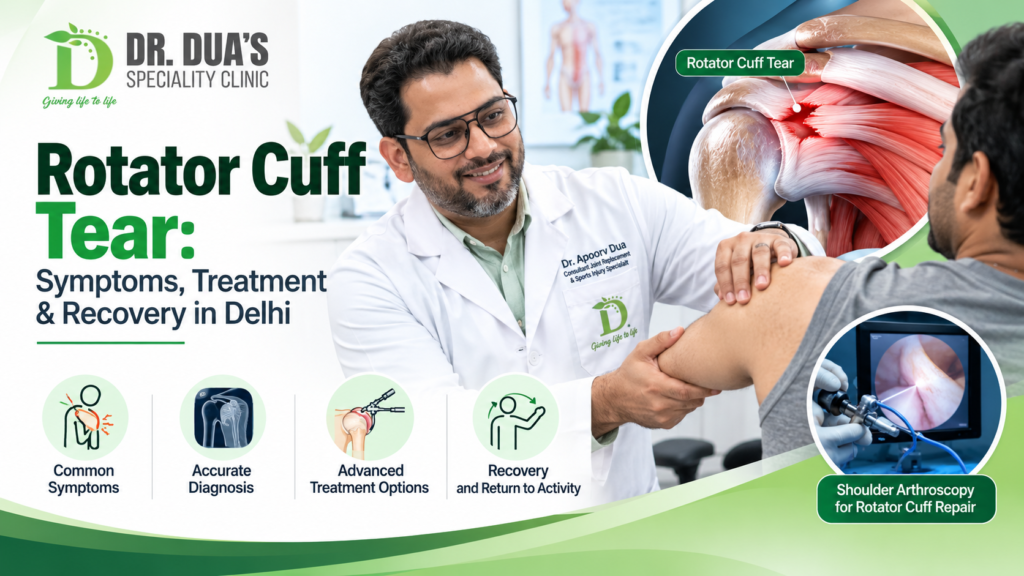
Reaching for a shelf, combing your hair, or turning in bed at night, and a deep ache in the shoulder stops you cold. Many people put it down to a “pulled muscle” and wait it out. But if the pain is stubborn and your arm feels weak, you may be dealing with a rotator cuff tear. Here is what that means, how it is treated and what recovery looks like.
Quick answer: A rotator cuff tear is a tear in one or more of the four tendons that stabilise and lift the shoulder. Typical signs are shoulder pain (often worse at night), weakness lifting the arm and difficulty reaching overhead. Small or partial tears often improve with physiotherapy and medical treatment, while large or full-thickness tears in active people may need arthroscopic (keyhole) repair. Recovery usually takes several months.
What is the rotator cuff?
The rotator cuff is a group of four muscles and their tendons that wrap around the top of the upper arm bone like a sleeve. They keep the ball of the shoulder centred in its socket and let you lift and rotate your arm. When one of these tendons frays or tears, even simple tasks feel heavy.
Symptoms of a rotator cuff tear
- A dull, deep ache in the shoulder, often worse at night or when lying on that side
- Weakness when lifting the arm or carrying things
- Pain when raising the arm to the side or overhead
- Difficulty reaching behind the back, for example while dressing
- A clicking or crackling sensation with movement
- A sudden “tearing” feeling after a fall or heavy lift (acute tear)
What causes it?
- Wear and tear: the tendon thins with age, and tears become more common after 40.
- Injury: a fall on an outstretched arm, a shoulder dislocation or lifting something heavy.
- Overuse: repeated overhead movements in cricket, badminton, swimming, gym training, painting or carrying loads.
- Poor posture and weak shoulder blade muscles: these increase pressure on the tendons.
Rotator cuff tear or frozen shoulder?
The two are often confused. In frozen shoulder, both active and passive movement are stiff and limited. In a rotator cuff tear, the joint usually moves when someone else lifts your arm, but you cannot lift it yourself because of weakness or pain. Read more in our guide on frozen shoulder symptoms and stages and how it compares with shoulder replacement. Other causes are covered in our post on shoulder pain treatment.
How is it diagnosed?
An orthopaedic surgeon will examine your shoulder strength and movement, and ask about the injury and your work or sport. An X-ray rules out bone problems. An ultrasound or MRI shows whether the tear is partial or full-thickness, and how large it is.
Treatment without surgery
Not every tear needs an operation. For partial tears, small tears or low-demand patients, treatment may include:
- Relative rest and avoiding painful overhead activity for a while
- Guided physiotherapy to strengthen the cuff and shoulder blade muscles
- Pain and inflammation control with medicines as advised by your doctor
- Injection therapies in selected cases, including GFC therapy for joint repair, after assessment
Many people improve in a few months. The structured exercises on our rehabilitation page explain the approach.
When is surgery needed?
Surgery is considered when:
- A full-thickness or large tear is causing weakness
- A recent traumatic tear occurs in a young or active person
- Pain and loss of function continue after 3 to 6 months of proper non-surgical treatment
- The tear is getting bigger on scans
Today, most repairs are done arthroscopically, through small keyhole cuts. The surgeon reattaches the torn tendon to the bone using small anchors. This usually means less pain and quicker early recovery than open surgery. Learn more about rotator cuff surgery in Delhi. In rare, severe cases of long-standing damage with arthritis, shoulder replacement surgery may be discussed.
Recovery after rotator cuff repair
- First 4 to 6 weeks: a sling protects the repair. Gentle passive movements are guided by the physiotherapist.
- 6 to 12 weeks: active movement gradually begins.
- 3 to 4 months: strengthening starts.
- 4 to 6 months or more: return to overhead work or sport, depending on tear size and healing.
The tendon needs time to heal back to the bone, so rushing exercises is the most common reason for re-tears. Follow the rehab plan closely.
Can you ignore it?
Small tears can sometimes remain mild, but untreated tears may enlarge over time, making repair harder and reducing the chance of a full recovery. If you have shoulder weakness or night pain for more than a few weeks, get it examined.
Consult Dr. Apoorv Dua in Greater Kailash II, South Delhi
Dr. Apoorv Dua is an orthopaedic surgeon with an IOA Inland Fellowship in Shoulder Arthroscopy and Sports Medicine (Ganga Hospital), and additional fellowships in joint replacement and ligament reconstruction. He sees patients at Dr. Dua’s Speciality Clinic, M-85, M Block, Greater Kailash II, New Delhi, Monday to Saturday, 9 AM to 7 PM. Explore his profile, our sports injury centre, or more articles on our blog.
Frequently asked questions
Can a rotator cuff tear heal on its own?
Tendon tears do not usually knit back by themselves, but many partial tears become pain-free with physiotherapy and proper care. Larger tears often need repair.
What does a rotator cuff tear feel like?
Most people feel a deep shoulder ache, night pain and weakness lifting the arm, sometimes with a clicking sensation.
How long does rotator cuff surgery take to recover?
Basic daily activities return in a few months. Full strength and return to sport often take 6 months or longer.
Is rotator cuff surgery painful?
There is pain after surgery, but modern anaesthesia, nerve blocks and medicines keep it manageable. Keyhole repair is generally less painful than open surgery.
Can I exercise with a rotator cuff tear?
Gentle, guided exercise is helpful, but avoid heavy lifting and painful overhead movements until your doctor clears it.
Which doctor should I see for a rotator cuff tear?
An orthopaedic surgeon, preferably one with shoulder arthroscopy experience, can diagnose and treat it.
How do I book an appointment?
Visit the appointment page or call +91-9034333133.
Shoulder pain not going away? Book an appointment with Dr. Apoorv Dua in Greater Kailash II, South Delhi.
Disclaimer: This article is for general information and does not replace a medical examination. Please consult a qualified doctor for diagnosis and treatment.
