

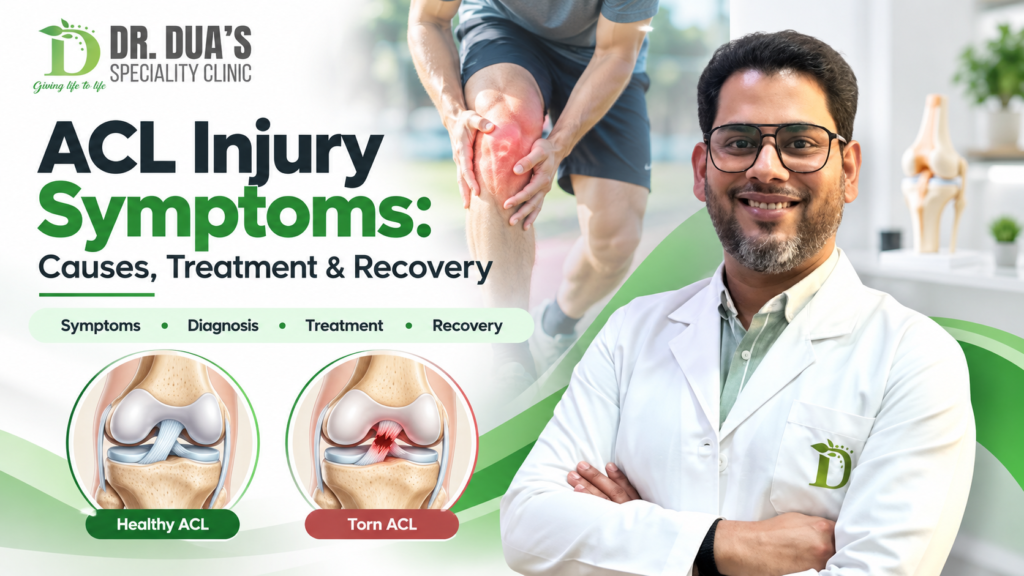
ACL Injury Symptoms: Causes, Treatment & Recovery
ACL injury symptoms commonly include knee pain, swelling, instability and difficulty walking after a sudden twist, awkward landing or sports-related accident. The anterior cruciate ligament (ACL) is one of the key ligaments that stabilise the knee joint. When it is stretched or torn, the injury can affect walking, exercise and participation in sports.
ACL injuries frequently occur during activities that involve sudden changes in direction, stopping quickly, jumping or landing. However, they can also happen during everyday activities or accidents.
Recognising ACL injury symptoms early and getting the knee assessed can help determine the severity of the injury and the most appropriate treatment. Depending on the extent of ligament damage, treatment may involve rehabilitation, activity modification or surgery.
What Is an ACL Injury?
The anterior cruciate ligament is a strong band of tissue inside the knee that connects the thighbone (femur) to the shinbone (tibia). It helps control forward movement of the tibia and provides rotational stability to the knee.
An ACL injury occurs when this ligament is stretched beyond its normal limits or torn. The injury may be classified as a sprain or a partial or complete tear, depending on the extent of damage.
ACL injuries are particularly common in sports involving football, basketball, badminton, tennis and other activities that require rapid changes in direction.
If you are experiencing knee instability after an injury, an orthopaedic assessment can help establish whether the ACL or another structure in the knee has been affected.
What Are the Common ACL Injury Symptoms?
ACL injury symptoms can vary according to the severity of the tear and whether other structures, such as the meniscus, are also injured.
1. A Popping Sensation
Some people hear or feel a pop in the knee at the moment of injury. Although this can occur with an ACL tear, a popping sound alone does not confirm ligament damage.
2. Knee Pain
Pain may develop immediately after the injury. Its intensity can vary, and some people may initially be able to walk despite having a significant ligament injury.
3. Swelling Around the Knee
Swelling can develop within the first few hours after an ACL injury. Rapid swelling may indicate bleeding inside the joint and should be assessed by a healthcare professional.
4. Knee Instability
The knee may feel as though it is giving way, particularly when turning, changing direction or walking on uneven ground. This sensation can be associated with reduced ligament stability.
5. Difficulty Walking or Bearing Weight
Pain, swelling and instability can make it difficult to walk normally or put weight on the affected leg.
6. Reduced Knee Movement
Swelling and pain may limit the ability to bend or straighten the knee fully.
These symptoms can also occur with meniscus tears, fractures and other knee injuries. Do not try to diagnose an ACL tear based on symptoms alone.
Seek prompt medical assessment if you develop substantial swelling, severe pain, difficulty bearing weight or a locked knee after an injury.
What Causes an ACL Tear?
An ACL tear often occurs when the knee experiences sudden force or an awkward movement. Common causes include:
- Suddenly changing direction while running.
- Stopping abruptly during a sport.
- Landing awkwardly after a jump.
- Twisting the knee while the foot remains planted.
- Direct impact during a collision.
- Accidents that place excessive force on the knee.
ACL injuries do not only affect professional athletes. Recreational players and people participating in everyday physical activities can also sustain ligament injuries.
Previous knee injuries, inadequate neuromuscular control and certain movement patterns may influence injury risk. However, an ACL tear can occur even when someone is physically fit and uses appropriate techniques.
How Is an ACL Injury Diagnosed?
An accurate diagnosis is important because several conditions can cause similar knee symptoms.
Physical Examination
An orthopaedic specialist will ask how the injury occurred, when the symptoms started and whether the knee feels unstable. The examination may include checking swelling, movement and ligament stability using specific clinical tests.
MRI Scan
Magnetic resonance imaging (MRI) can help identify ACL damage and assess associated injuries involving the meniscus, cartilage and other ligaments.
X-rays
X-rays may be recommended to look for fractures or other bone abnormalities. An X-ray does not directly show an ACL tear, because ligaments are soft tissues.
Not every knee injury requires every imaging test. The appropriate investigations depend on the clinical examination and suspected injury.
What Are the Treatment Options for an ACL Injury?
ACL treatment depends on the severity of the injury, knee stability, associated damage, activity requirements and individual goals. Not every ACL tear requires surgery.
1. Initial Injury Management
During the early stage, a healthcare professional may recommend protecting the knee, modifying activities, applying a cold pack wrapped in a towel and elevating the leg to help manage discomfort and swelling.
Avoid returning to sports or forcing the knee through painful movements before it has been assessed. If you cannot bear weight, have severe pain or notice significant swelling, seek prompt medical attention.
2. Physiotherapy and Rehabilitation
Some ACL injuries can be managed without surgery, particularly when the knee is stable enough for the person’s daily activities and rehabilitation goals.
A structured rehabilitation programme may focus on:
- Restoring knee movement.
- Reducing swelling.
- Strengthening the quadriceps and hamstring muscles.
- Improving balance and coordination.
- Developing control during walking and functional movements.
Rehabilitation is also an important part of recovery for patients who undergo ACL reconstruction.
3. ACL Reconstruction Surgery
ACL reconstruction may be considered when the ligament is significantly torn and the knee remains unstable, particularly for people who wish to return to sports involving pivoting or rapid direction changes.
During ACL reconstruction, the surgeon generally uses a graft to replace the damaged ligament. The procedure is commonly performed using arthroscopic techniques, which involve a camera and specialised instruments inserted through small incisions.
The decision to undergo surgery depends on the patient’s examination, activity goals, associated injuries and response to non-surgical management. Surgery is not automatically necessary for every ACL tear.
For more information about the procedure, visit ACL and PCL surgery in Delhi with Dr. Apoorv Dua.
How Long Does ACL Injury Recovery Take?
ACL injury recovery varies depending on the severity of the injury, the treatment selected, associated damage and the person’s progress during rehabilitation.
People with less severe injuries managed without surgery may improve over several weeks or months. However, symptoms alone cannot determine whether the ligament has healed sufficiently for sports.
After ACL reconstruction, rehabilitation typically progresses through several stages:
Early Recovery
The initial focus is on managing swelling, restoring knee movement, activating the thigh muscles and improving safe mobility.
Strength and Stability Training
As recovery progresses, physiotherapy may introduce strengthening, balance and movement-control exercises tailored to the patient’s progress.
Running and Sport-Specific Training
Running, jumping, cutting and pivoting activities are introduced only when the knee meets appropriate clinical and functional criteria.
Returning to high-demand sports after ACL reconstruction commonly takes around 9–12 months or longer, depending on recovery and testing. This is a general estimate, not a fixed deadline. Returning too early may increase the risk of another injury.
Follow the treating surgeon’s and physiotherapist’s advice rather than relying on a calendar alone.
For guidance on rehabilitation after ACL reconstruction, explore orthopaedic rehabilitation resources from Dr. Apoorv Dua.
Can ACL Injuries Be Prevented?
Not every ACL injury can be prevented, but appropriate training may help reduce risk.
Warm Up Before Exercise
Begin sports sessions with a suitable warm-up that prepares the muscles and joints for physical activity.
Improve Leg Strength
Exercises targeting the quadriceps, hamstrings, hips and core can support movement control and knee function.
Practise Safe Landing Techniques
Learning to land with good control and avoid excessive inward knee movement may help reduce stress on the knee during jumping activities.
Develop Balance and Coordination
Balance and neuromuscular training can improve control during sudden movements and changes of direction.
Increase Training Gradually
Avoid sudden increases in training intensity or volume. Allow time for recovery between demanding sessions.
A sports physiotherapist or qualified healthcare professional can help develop a suitable injury-prevention programme based on individual needs.
When Should You Consult an Orthopaedic Specialist?
You should seek an assessment if you experience knee instability, substantial swelling, persistent pain or difficulty returning to normal activities after a twisting injury.
A knee that repeatedly gives way may require further investigation, even if the initial pain has improved.
Prompt assessment is especially important when the knee is locked, the leg cannot bear weight or there is concern about a fracture or another serious injury.
An orthopaedic specialist can evaluate the injury, recommend appropriate investigations and discuss the available treatment options.
Frequently Asked Questions About ACL Injuries
What are the first symptoms of an ACL tear?
Common symptoms include a popping sensation at the time of injury, knee pain, swelling, instability and difficulty bearing weight. However, these symptoms can occur with other knee injuries too.
Can an ACL tear heal without surgery?
Some ACL injuries can be managed without surgery through activity modification and structured rehabilitation. The appropriate approach depends on the extent of damage, knee stability and the person’s activity goals.
Is an MRI necessary to diagnose an ACL injury?
An MRI is often useful for assessing ACL damage and associated injuries. The decision to order an MRI depends on the physical examination and the suspected condition.
How long does ACL reconstruction recovery take?
Recovery varies between individuals. Returning to pivoting sports commonly takes around 9–12 months or longer after reconstruction and depends on strength, stability, functional testing and clinical clearance.
Can I walk with a torn ACL?
Some people can walk with an ACL tear, while others experience pain, swelling or instability. Being able to walk does not rule out a significant injury.
Can ACL injuries happen without playing sports?
Yes. An ACL injury can occur during falls, accidents or everyday movements involving sudden twisting or force on the knee.
Conclusion
ACL injury symptoms such as knee swelling, pain, instability and difficulty bearing weight should not be ignored after a twisting injury or sports accident. Early assessment can help identify the extent of ligament damage and determine whether rehabilitation, activity modification or surgery may be appropriate.
Recovery requires an individualised treatment plan and, when indicated, structured rehabilitation. Returning to sports should depend on knee function and clinical assessment rather than pain relief alone.
For information about ACL injury assessment and treatment options, visit Dr. Apoorv Dua’s ACL and PCL surgery page.
Medical Disclaimer
This article is intended for general educational purposes only and does not replace professional medical advice, diagnosis or treatment. Treatment decisions should be based on an individual clinical assessment.
About the Author
Dr. Apoorv Dua — Orthopaedic Surgeon
Dr. Apoorv Dua’s website lists qualifications including MBBS, MS Orthopaedics, fellowships in joint replacement and ligament reconstruction, shoulder arthroscopy and sports medicine, and a FIFA Diploma in Football Medicine. His areas of practice include joint replacement, sports injuries, arthroscopy and fracture management.
This article provides general information about ACL injuries and treatment options. Individual diagnosis and treatment recommendations require a clinical consultation.
Explore More Orthopaedic Care
Learn more about ACL treatment and rehabilitation through these related resources.
- ACL and PCL Surgery in Delhi — Learn about knee ligament injuries, diagnosis and reconstruction options.
- Orthopaedic Rehabilitation Guides — Explore rehabilitation resources for ACL reconstruction and other orthopaedic procedures.
- Sports Injury Treatment in Delhi — Learn about the assessment and management of sports-related injuries.
Need an Orthopaedic Assessment?
If knee pain, swelling or instability is affecting your daily activities, seek an appropriate medical assessment.
Visit Dr. Apoorv Dua’s website for clinic information and appointment details.
