

Robotic Knee Replacement in Delhi: Is It Worth It? Cost, Benefits & Recovery
A recent nationwide review found that nearly 1 in 5 Indians develops knee osteoarthritis, with some studies placing the number as high as 28-47% among older adults — and the numbers are only climbing as life expectancy and obesity rates increase across the country. If you’re one of the many people in Delhi who’s been told “your knee is wearing out” and now you’re hearing the word “robotic” thrown around by doctors, you’re probably wondering — is this just an expensive buzzword, or is there real substance behind it?
Let’s break it down honestly. No sales pitch, just what robotic knee replacement actually is, who it’s really for, what recovery looks like, and how to think about the decision if you or a loved one is staring at a worn-out knee.
What Exactly Is Robotic Knee Replacement?
Here’s the simplest way to think about it: robotic knee replacement isn’t a robot doing surgery on its own. The surgeon is in complete control from start to finish — the robotic arm is essentially a highly precise guidance tool.
Before the surgery, a 3D scan of your knee is taken. This creates a personalized map of your bone structure, joint alignment, and ligament balance. Based on this map, the surgical plan is customized to your anatomy — not a one-size-fits-all template. During the actual procedure, the robotic arm helps the surgeon make bone cuts within a fraction of a millimeter of the plan, and it physically restricts movement outside the planned boundary, which reduces the chance of human error affecting alignment.
In short: robotic knee replacement in Delhi combines a surgeon’s experience and judgment with a level of precision that’s difficult to achieve with the naked eye and hand alone.
Robotic vs Traditional Knee Replacement: What’s the Real Difference?
This is probably the question patients ask the most, and rightly so — because both procedures ultimately do the same job: replace a damaged knee joint with an artificial one.
The difference lies in how it’s done.
In traditional knee replacement, the surgeon relies on manual instruments, visual judgment, and years of hands-on experience to determine cutting angles and implant positioning. This has worked well for decades and many patients have excellent outcomes with conventional surgery.
In robotic vs traditional knee replacement, the robotic-assisted approach adds a layer of digital precision on top of that experience. The 3D mapping allows the surgeon to “test drive” the implant position virtually before making any cuts, adjust soft tissue balance more accurately, and avoid over-correction or under-correction of alignment — which is one of the most common reasons patients feel like their replaced knee “doesn’t feel natural.”
For patients with significant deformity, previous injuries, or unusual bone anatomy, this added precision can make a meaningful difference. For relatively straightforward cases, a skilled surgeon may achieve similarly good results with traditional methods. The right approach really depends on your specific knee, not just personal preference.
Benefits of Robotic Knee Replacement
When people ask about robotic knee replacement benefits and risks, the benefits side of the conversation usually includes:
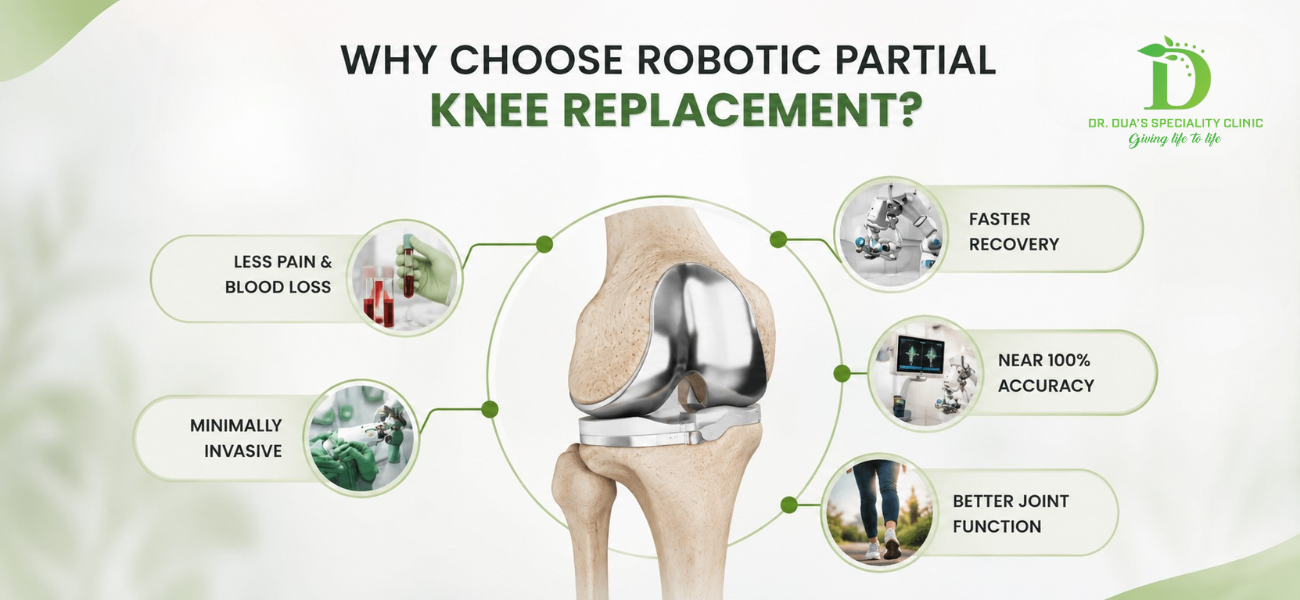
Better implant alignment and fit — Because the surgical plan is based on your own 3D scan, the implant is positioned to match your natural joint mechanics more closely, rather than a generic average.
Reduced soft tissue damage — The robotic arm helps the surgeon work within precise boundaries, which often means less disruption to the muscles and ligaments surrounding the knee.
More consistent outcomes — Precision reduces the variability that can sometimes occur with manual techniques, especially in complex cases.
Potentially faster early recovery — Many patients report being able to start walking with support within a day or two after surgery, though this also depends heavily on the patient’s overall health and the rehab program followed.
Long-term joint longevity — Better alignment generally means less uneven wear on the implant over time, which can extend how long the artificial joint lasts.
What About the Risks?
No surgery is risk-free, and robotic knee replacement is no exception. The risks are broadly similar to those of any knee replacement surgery — infection, blood clots, stiffness, or nerve irritation — and the robotic technology itself doesn’t eliminate these. What it does is reduce certain technical risks related to alignment and positioning.
It’s also worth knowing that not every patient is automatically a candidate. People with very advanced bone loss, certain prior surgeries, or specific medical conditions may need a different surgical approach altogether. This is exactly why a proper in-person evaluation matters more than going purely by what’s trending online.
Robotic Knee Replacement Cost in Delhi: What You Should Know
Let’s address this directly, because it’s usually the first question on everyone’s mind.
The robotic knee replacement cost in Delhi isn’t a single fixed number — it varies quite a bit based on several factors: the hospital you choose, the type and brand of implant (Indian vs imported), the surgeon’s experience, the duration of hospital stay, room category, and any pre-existing conditions that require additional management during and after surgery.
Rather than fixating on a number you find online (which often varies wildly between sources anyway), the more useful approach is to get a personalized estimate after your evaluation — this way you know exactly what’s included, whether your insurance or cashless facility applies, and there are no surprises later. Most reputable clinics, including Dr. Dua’s Speciality Clinic, are happy to walk you through this transparently once your case has been assessed.
Robotic Knee Replacement Recovery Time: What to Realistically Expect
This is where a lot of myths float around, so let’s set realistic expectations for robotic knee replacement recovery time.
First 24-48 hours: Most patients are encouraged to sit up and start gentle movement, often walking a few steps with support, within a day of surgery. This early mobilization is one of the biggest advantages of modern knee replacement protocols overall.
First 2 weeks: This is the phase where pain management, wound care, and basic mobility exercises are the focus. Most patients are home within 3-5 days, sometimes sooner.
2-6 weeks: Physiotherapy becomes the main job here. Building strength, improving range of motion, and gradually reducing dependence on a walker or cane.
6 weeks to 3 months: Most people can resume daily activities — walking without support, climbing stairs more comfortably, driving short distances (once cleared by the doctor).
3-6 months: Continued improvement in strength and stamina. Many patients return to low-impact activities like swimming or cycling during this window.
The second robotic knee replacement recovery time point is worth noting: recovery isn’t just about the surgery itself — it’s heavily influenced by how consistently you follow the physiotherapy plan. Two patients with identical surgeries can have very different recovery experiences based on this single factor alone.
Is Robotic Knee Replacement Worth It?
Honestly — it depends on your specific situation, and that’s not a cop-out answer.
If you’ve been dealing with knee pain that’s limiting your daily life — struggling with stairs, unable to sit cross-legged, pain that doesn’t improve with medication or physiotherapy anymore — and a doctor has confirmed that replacement is the right path, then the added precision of the robotic approach is generally seen as a worthwhile investment, especially for complex knee deformities or younger, more active patients who want their implant to last as long as possible.
If your knee issue is at an earlier stage and can still be managed with non-surgical options — weight management, physiotherapy, medication, or regenerative treatments like GFC therapy — then jumping straight to surgery (robotic or otherwise) may be premature.
This is really the core of the decision: robotic knee replacement in Delhi is a tool, and like any tool, its value depends on whether it’s the right one for the job in front of you.
Choosing the Right Surgeon Matters More Than the Robot
Here’s something that often gets lost in all the marketing around robotic technology: the robot doesn’t make the decisions — the surgeon does. The technology is only as good as the person operating it.
When looking for the best robotic knee replacement surgeon in Delhi, experience with both traditional and robotic techniques matters, because a surgeon who understands when not to rely purely on the robotic plan — and adjust based on real-time findings during surgery — tends to deliver more consistent results.
Dr. Apoorv Dua brings over a decade of experience in joint replacement and reconstruction, with specialized fellowship training in joint replacement and ligament reconstruction. At Dr. Dua’s Speciality Clinic in Greater Kailash II, the focus has always been on a patient-first approach — recommending surgery only when it’s genuinely the right step, and exploring non-surgical options like GFC therapy first wherever appropriate.
Knee Pain Treatment in Greater Kailash / GK2: Why Location Matters Too
If you’re based in South Delhi, finding a clinic close to home isn’t just about convenience — it actually impacts your recovery. Physiotherapy sessions, follow-up visits, and post-op check-ups are frequent in the first few months, and traveling long distances repeatedly can genuinely slow down your rehab consistency.
For residents looking for knee pain treatment Greater Kailash / GK2, having access to a clinic within the neighborhood means follow-ups are easier to keep up with, which — as mentioned earlier — directly affects how well your recovery goes.
For anyone exploring knee replacement surgery South Delhi options, proximity combined with a doctor who genuinely takes time to explain your specific case (rather than rushing through consultations) makes a real difference in how confident you feel through the process.
Frequently Asked Questions
- How do I know if I need a knee replacement at all? If you have persistent knee pain that limits walking, climbing stairs, or daily activities, and it hasn’t improved significantly with medication, physiotherapy, or lifestyle changes over several months, it’s time for a proper evaluation. X-rays and a clinical assessment will determine the actual stage of joint damage.
- At what age is robotic knee replacement usually recommended? There’s no fixed age cutoff. While many patients are in their 60s and 70s, younger patients with severe arthritis, post-traumatic joint damage, or sports injuries that have led to advanced wear can also be candidates. Age is just one factor among several.
- Is robotic knee replacement more painful than traditional surgery? Not inherently. Pain levels depend more on the individual’s pain tolerance, the surgical technique used for tissue handling, and post-op pain management protocols — not specifically on whether the robot was involved.
- How long does the surgery itself take? A robotic knee replacement procedure typically takes a bit longer than traditional surgery because of the additional planning and scanning steps, though the exact duration varies based on the complexity of the individual case.
- Can both knees be done at the same time? In some cases, bilateral knee replacement (both knees together) is possible, but this decision depends on the patient’s overall health, age, and the surgeon’s assessment of surgical risk versus recovery benefit.
- Will I need to use a walker or cane after surgery? Yes, initially. Most patients use a walker for the first few weeks, transitioning to a cane, and eventually walking unassisted as strength and balance improve — usually over 4-6 weeks.
- Is robotic knee replacement covered by insurance? Many health insurance policies in India do cover knee replacement surgery, including robotic-assisted procedures, though coverage details vary by insurer and policy. It’s best to check directly with your insurance provider and the hospital’s insurance desk.
- How long does the implant actually last? Modern knee implants are generally expected to last 15-20 years or more, with proper care. Better alignment — one of the advantages of the robotic approach — can contribute to reduced wear over time.
- What’s the difference between partial and total knee replacement? Partial knee replacement only replaces the damaged portion of the joint, while total knee replacement replaces the entire joint surface. Robotic assistance can be used for both, depending on the extent of damage.
- When can I start driving again after surgery? Most patients are able to resume driving around 6-8 weeks post-surgery, once they have enough strength and control to operate pedals safely and comfortably — though this should always be confirmed with your surgeon based on your individual recovery.
The Bottom Line
Robotic knee replacement isn’t a magic fix, and it isn’t right for everyone — but for the right patient, it offers a level of precision and personalization that can genuinely improve outcomes and longevity. The technology is a tool in an experienced surgeon’s hands, not a replacement for that experience.
If knee pain has been holding you back and you’re trying to figure out whether surgery — robotic or otherwise — is the right next step, the best starting point is a thorough, honest evaluation rather than going by cost comparisons or trending searches alone.
Have questions about your specific knee condition? Reach out to Dr. Dua’s Speciality Clinic on WhatsApp for guidance on your next steps.
