

Knee Pain in Your 30s and 40s? Here's Why It's Happening and What You Can Do About It
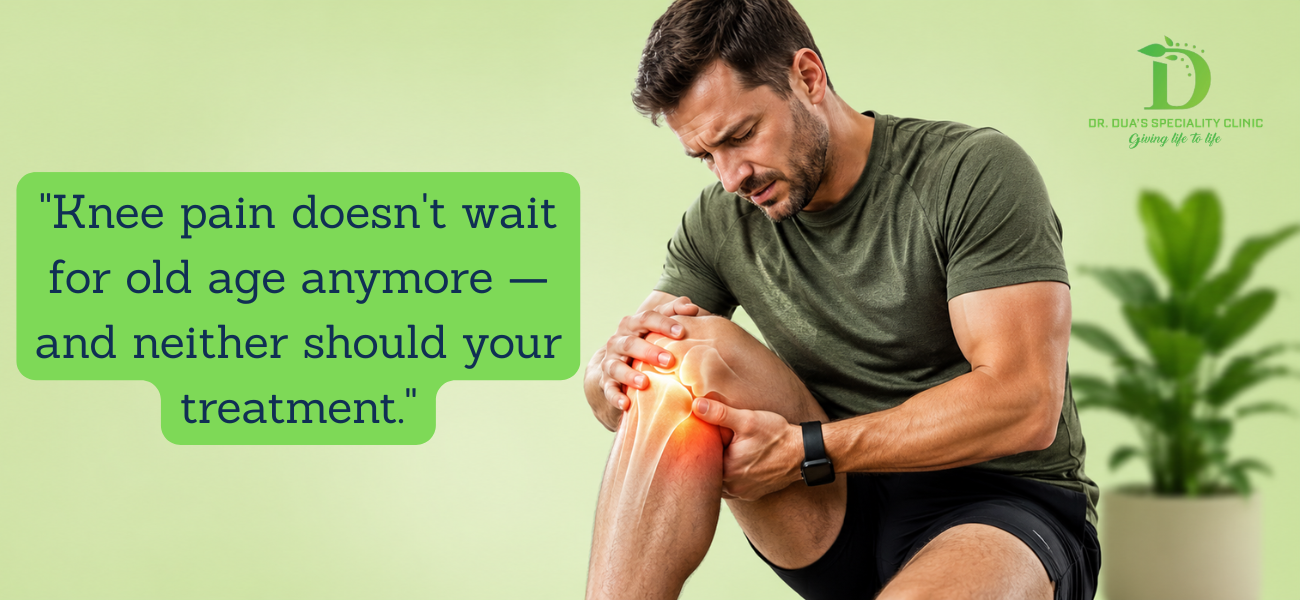
Let me tell you about a patient I saw recently.
He was 34 years old. Software engineer. Works from home. Logs 10–12 hours a day at a desk, maybe takes a 10-minute walk to the kitchen and back. Every weekend, he goes for a long run or hits the gym hard — trying to “make up” for the week. Two months ago, he started noticing a dull ache under his kneecap. Then stiffness when he stood up from his chair. Then pain while climbing the stairs to his apartment.
He waited three more months before coming to see me. When he finally did, he told me: “Doctor, I thought knee pain was for 60-year-olds. I’m only 34.”
I hear some version of this every single week.
Knee pain in your 30s and 40s is no longer rare. It has become one of the fastest-growing complaints in my OPD — and across orthopedic clinics in Delhi. If you are reading this because your knee has been bothering you and you have been brushing it off, this blog is for you.
Knee pain is no longer an “old age” problem — the numbers prove it
The Times of India and India TV News have both covered this in 2025–26: knee complaints are surging among Indians aged 30 to 45. This is not anecdotal. Research published by orthopedic institutions shows that over half of adults in their 30s already show early signs of cartilage damage on MRI scans — even when they feel no symptoms yet.
In Delhi specifically, this shift is visible across orthopedic OPDs in South Delhi — and I see it firsthand at my clinic in Greater Kailash II. Patients who once came in their 50s and 60s are now walking in their 30s and 40s.
This shift has a reason. Actually, several.
7 real reasons knee pain is hitting younger Delhiites today
1. Sitting 8–10 hours a day — and calling it fine
The biggest culprit, and the one nobody talks about enough.
When you sit for long hours, the muscles around your knee — especially the quadriceps (front of thigh) and glutes — become weak and tight. These muscles are the main shock absorbers and stabilizers for your knee joint. When they weaken, the joint itself takes the load it was never meant to handle alone.
A 32-year-old developer sitting through back-to-back meetings is unknowingly loading stress onto his knee cartilage every single day. This is how early wear begins — silently, without dramatic injury, without any warning.
If your job keeps you seated for most of the day, your knees are at risk. Full stop.
2. The “weekend warrior” trap
This one is extremely common in South Delhi — Vasant Kunj, GK, Hauz Khas, Saket. Monday to Friday: zero exercise. Saturday and Sunday: 10 km run, heavy squats, CrossFit session.
Your knee cartilage does not recover fast enough from sudden high-intensity stress when the muscles supporting it are deconditioned. The result is micro-damage that accumulates over weeks and months. One day it becomes pain you cannot ignore.
In my experience, this pattern — complete rest during weekdays followed by intense weekend activity — is one of the top three reasons young patients in Greater Kailash and surrounding areas end up in my OPD with knee complaints.
3. Vitamin D deficiency — India’s silent epidemic
This is a statistic that genuinely shocks most of my patients: 81% of Indian adults in the 25–40 age group are vitamin D deficient, according to a study by ICRIER and ANVKA Foundation (2025). Delhi ranks among the most affected cities.
Vitamin D deficiency weakens both bones and the muscles around joints. It leads to joint stiffness, slow cartilage repair, and increased inflammation. When knee cartilage is already under pressure from a sedentary lifestyle, low vitamin D makes the damage progress faster.
The bitter irony? India gets more sunlight than almost any country in the world — yet we have some of the highest deficiency rates globally. Indoor office culture, sunscreen overuse, and low dietary intake are the main reasons.
A simple blood test (25-OH Vitamin D) can check your levels. Many of my patients are surprised to discover this is contributing to their knee pain.
4. Weight gain during the WFH era
Every kilogram of excess body weight puts roughly 3–4 times that force on your knee joint with every step. So even 5 extra kilograms means your knee absorbs 15–20 additional kilograms of force thousands of times a day.
Post-pandemic, most urban professionals in Delhi gained weight from reduced movement and stress eating. This quietly accelerated early cartilage wear in millions of people who had no idea it was happening.
India now has one of the world’s fastest-growing obesity rates. Combined with a sedentary lifestyle, the knees of a 38-year-old today may functionally resemble those of a 55-year-old from a decade ago.
5. Gym injuries that were never properly treated
An ACL sprain from a football game at 26. A meniscus irritation after an intense gym session at 29. A knee twist during trekking at 31.
These happen. What also happens — very commonly — is that people treat them with two days of rest, maybe some painkillers, and then go straight back to activity without proper rehabilitation. The injury never truly healed. The biomechanics of the knee changed subtly. And a few years later, that same knee starts hurting with ordinary activity.
Untreated ligament and meniscus injuries are a major driver of early knee arthritis in the 30s and 40s. If you had a knee injury in the past that you shrugged off, it may be silently contributing to what you feel today.
6. Poor posture and flat feet
Many people in Delhi — especially those who grew up wearing chappals or flat shoes without arch support — have flat feet (pes planus). When your foot arch is flat, the ankle rolls inward. The knee follows. This misalignment puts constant uneven pressure on the inner side of the knee.
Similarly, working hunched forward at a laptop all day changes the alignment of your entire lower body. The hip turns inward. The knee takes a different load pattern than it was designed for. Over years, this creates the kind of wear that shouldn’t appear until much later in life.
7. Low protein intake and muscle loss
This is especially common among vegetarians, which includes a large proportion of Delhi’s population. Without adequate dietary protein, the muscles that support the knee cannot be built or maintained effectively. Weak muscles = overloaded joint = faster cartilage wear.
Combined with sitting all day and skipping targeted strengthening exercises, most urban professionals in their 30s and 40s have significantly weaker legs than they realize — even those who hit the gym regularly but skip lower-body work.
8. Living in Greater Kailash, Vasant Kunj, or South Delhi? Your lifestyle adds to the risk
This point is specific — and important.
South Delhi neighbourhoods like Greater Kailash I and II, Vasant Kunj, Hauz Khas, Saket, and Malviya Nagar are home to a large population of working professionals, business owners, and young families. The lifestyle here is typically high-pressure: long work hours, frequent dining out, car-dependent commuting, and limited time for structured exercise.
At my clinic in Greater Kailash II, I see this combination regularly — patients who walk very little during the week (everything from parking to office to home is minimized), eat high-calorie restaurant food several times a week, and then suddenly do intense physical activity on weekends when they have time.
Add to this the fact that many South Delhi apartments and offices involve elevator use rather than stair climbing — so the knee barely gets any regular low-impact movement, while also never getting the muscle-building stimulus it needs.
If you live or work in the Greater Kailash, Vasant Kunj, or Lajpat Nagar area and your knee has been bothering you, Dr. Dua’s Speciality Clinic at M-85, Greater Kailash II is within easy reach. Most patients from these neighbourhoods are able to visit during lunch breaks or after office hours — we are open Monday to Saturday, 9 AM to 7 PM.
Early evaluation takes 30–40 minutes. It can save you years of pain.
Warning signs you must not ignore
Many patients in their 30s dismiss knee symptoms because they seem mild. Here is what your knee may be telling you — and why you should listen:
Do not wait if you notice:
- Pain or stiffness when you stand up after sitting for 20–30 minutes
- Aching under or around the kneecap during or after exercise
- A grinding or clicking sensation when bending the knee
- Swelling around the knee — even mild and occasional
- Pain when climbing or descending stairs
- Knee giving way or feeling unstable
Any one of these symptoms, lasting more than 2–3 weeks, is reason enough to see an orthopedic specialist. The earlier you come in, the more options we have — and the more likely we can help you avoid surgery entirely.
What treatment looks like when you come in early
Here is the important thing most people do not know: when knee pain is caught early, the majority of cases can be managed without surgery. Here is what I typically offer patients in the 30–45 age group:
Physiotherapy and muscle strengthening — This is almost always the starting point. Targeted exercises that strengthen the quadriceps, glutes, and hamstrings reduce the load on the knee joint significantly. Done correctly and consistently, physiotherapy alone resolves many early cases.
Lifestyle correction — Sitting breaks every 45–60 minutes, ergonomic workstation adjustments, gradual return to exercise, weight management. These are not vague suggestions — I give patients specific, practical protocols.
Vitamin D and nutritional correction — We check levels and correct deficiencies with supplementation. This alone can significantly reduce joint stiffness and pain in patients where deficiency is contributing.
GFC Therapy (Growth Factor Concentrate) — For patients with early cartilage damage, GFC therapy uses concentrated growth factors from your own blood to promote tissue repair and reduce inflammation. It is minimally invasive, done as an outpatient procedure, and has shown excellent results in younger patients with early joint damage. Read more about GFC Therapy →
PRP (Platelet-Rich Plasma) injections — Similar principle to GFC, effective particularly for tendon and ligament-related knee pain in active young patients.
Knee replacement is rarely needed in this age group when treatment begins early. But when patients delay by 3–5 years, what could have been managed conservatively sometimes does progress to a point where more intervention becomes necessary. This is exactly why early evaluation matters.
What you can do starting today — 5 practical steps
You do not need to wait for an OPD visit to begin protecting your knees. Start here:
- Get up every 45–60 minutes. Set a timer at your desk. Stand, walk 2–3 minutes, stretch your legs. This single habit reduces continuous load on the knee joint dramatically.
- Add 15 minutes of targeted strengthening 4 days a week. Wall sits, straight leg raises, clamshells, and glute bridges. These exercises specifically strengthen the muscles that protect the knee. No gym required.
- Get your Vitamin D tested. Ask your GP or come see us. A 25-OH Vitamin D blood test costs under ₹600 and tells you everything. If you are deficient (most urban Delhiites are), correction is straightforward.
- Wear proper footwear. If you have flat feet, arch-support insoles make a meaningful difference. Avoid flat chappals for long walks.
- Do not push through sharp knee pain at the gym. “No pain no gain” does not apply to your knee joint. If a movement hurts, stop. Modify. Consult. Continuing through pain in the hope it will resolve is one of the most common ways minor injuries become serious ones.
A message from Dr. Apoorv Dua
Knee pain at 35 is not normal. It is a signal worth taking seriously — not with panic, but with attention.
The encouraging reality is that for most young patients, we have excellent non-surgical options today. Regenerative treatments like GFC therapy, targeted physiotherapy, and proper lifestyle correction have genuinely changed outcomes for patients who would previously have been told to “live with it” or face surgery.
But timing matters. The cartilage in your knee does not regenerate on its own once significantly damaged. Catching the problem early — while the damage is still mild — is the difference between a conservative treatment plan and a surgical one.
If your knee has been bothering you for more than a few weeks, I would encourage you to come in for a proper assessment. Not because you necessarily need treatment, but because knowing where you stand gives you the power to protect your joint for the next 40 years.
Book a Consultation
Dr. Dua’s Speciality Clinic M-85, 80 Feet Rd, Block M, Greater Kailash II, New Delhi – 110048
OPD Timings: Monday to Saturday | 9 AM – 7 PM
Call / WhatsApp: +91-9034333133 Email: drduamultispecialitycentre@gmail.com
Book Appointment on WhatsApp →
Frequently Asked Questions
Q: Why does my knee hurt at 35? I thought this was an old-age problem. Knee pain in your 30s and 40s is increasingly common, especially among urban professionals. Prolonged sitting, sudden intense exercise, vitamin D deficiency, past injuries, and weight gain are the main causes. It is not normal and should be evaluated — but it is very treatable when caught early.
Q: Is my knee pain serious or just muscle soreness? Muscle soreness after exercise typically resolves within 48–72 hours. If your knee pain persists beyond 2–3 weeks, is associated with swelling, clicks, or instability, or occurs during ordinary activities like sitting and stair climbing — it deserves a proper orthopedic assessment.
Q: Can I exercise with knee pain? It depends on the cause and severity. In most early cases, specific low-impact strengthening exercises are actually recommended. High-impact activities should be modified until you have been properly assessed. Do not stop moving entirely — but do not push through pain either.
Q: Do I need an MRI for knee pain? Not always. For many patients, a clinical examination and an X-ray are sufficient for an initial assessment. MRI is recommended when soft tissue damage (cartilage, meniscus, ligaments) is suspected.
Q: Can knee pain at this age lead to knee replacement later? If the underlying cause is addressed early and cartilage damage is minimal, the vast majority of patients in the 30–45 age group can protect their knees for decades without needing replacement. This is exactly why early evaluation matters.
